







Published on April 20, 2026
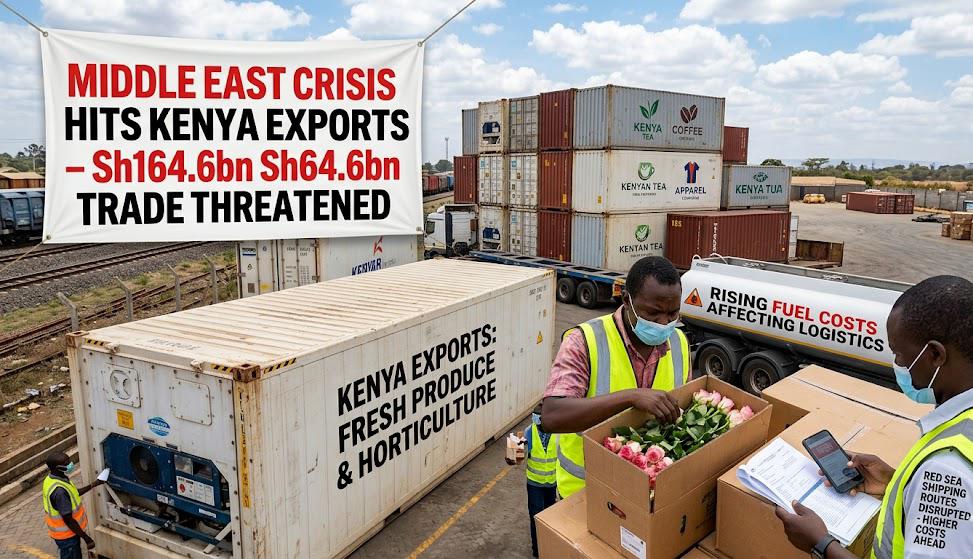
Kenya’s export sector is facing fresh turbulence as the ongoing Middle East crisis disrupts key trade routes. Up to KSh164.6 billion worth of annual exports are now at risk. The situation has exposed the country’s heavy reliance on the Gulf region as both a logistics hub and a market.
A briefing from the Ministry of Investments, Trade and Industry warns that the geopolitical tensions are already shaking global supply chains. Kenyan exporters are experiencing delays, rising freight costs, and shrinking market access. The Middle East accounts for a large share of Kenya’s outbound trade, especially in tea, horticulture, and manufactured goods.
Officials say the crisis is not only hurting direct exports to Gulf markets. It is also disrupting transshipment routes that connect Kenya to Europe, Asia, and North America.
Pros and Cons of Alternate Routes
Shipping and air cargo routes through the Red Sea and Gulf corridors have been cut back. Transit times have increased by as much as 20 days, according to a statement by CS Lee Kinyanjui. Air freight delays of up to 48 hours are making things worse for perishable exports such as flowers and fresh produce.
Exporters are now dealing with a surge in logistics costs. Rising global oil prices are the main driver. Fuel accounts for nearly half of transport expenses, putting extra pressure on already thin profit margins.
Most Affected Sectors are Tea, Flowers, & Meat.
The impact is already visible across different sectors. Flower exporters are reporting weekly losses because their products spoil before reaching buyers. Meat exports have in some cases dropped to below five percent of normal volumes.
Tea is one of Kenya’s top foreign exchange earners. It faces declining prices because of reduced access to a market that normally absorbs up to 35 percent of its exports.
Remittances Also at Risk?
The disruption is expected to spill over into remittances, which are a critical pillar of Kenya’s foreign exchange inflows. More than 400,000 Kenyans work in Gulf countries. Any slowdown in those economies could tighten inflows that have recently hit record highs. However, March figures suggest the crisis might also trigger a short-term surge in remittances as workers send money home in response to uncertainty.
Government Response: Diversification and Emergency Measures
The crisis has renewed urgency around diversifying Kenya’s export markets and logistics pathways. Officials say the country is speeding up outreach to Asia, Europe, and Latin America. At the same time, Kenya is deepening trade within Africa under frameworks such as the African Continental Free Trade Area and the East African Community.
“The current situation shows the risks of over-relying on single corridors,” the ministry said. This signals a longer-term policy shift toward building resilience in trade infrastructure.
The government has also rolled out several emergency and medium-term interventions to stabilize the export sector. Immediate measures include a reduction in Value Added Tax on petroleum products from 16 percent to 8 percent. This is meant to ease fuel-driven cost pressures.
Authorities have activated a multi-agency team to monitor freight costs, fuel pricing, and supply chain disruptions. Efforts are also underway to secure alternative cargo routes in partnership with Kenya Airways and international logistics partners. Meanwhile, operational efficiency is being improved at the Port of Mombasa and Lamu Port to reduce bottlenecks.
For this kind of news and more, visit us at MUIAA Ltd where we offer research, advice and build modern day innovations in blockchain, fintech, and digital finance across emerging markets. We help turn ground-level realities into practical financial tools.