

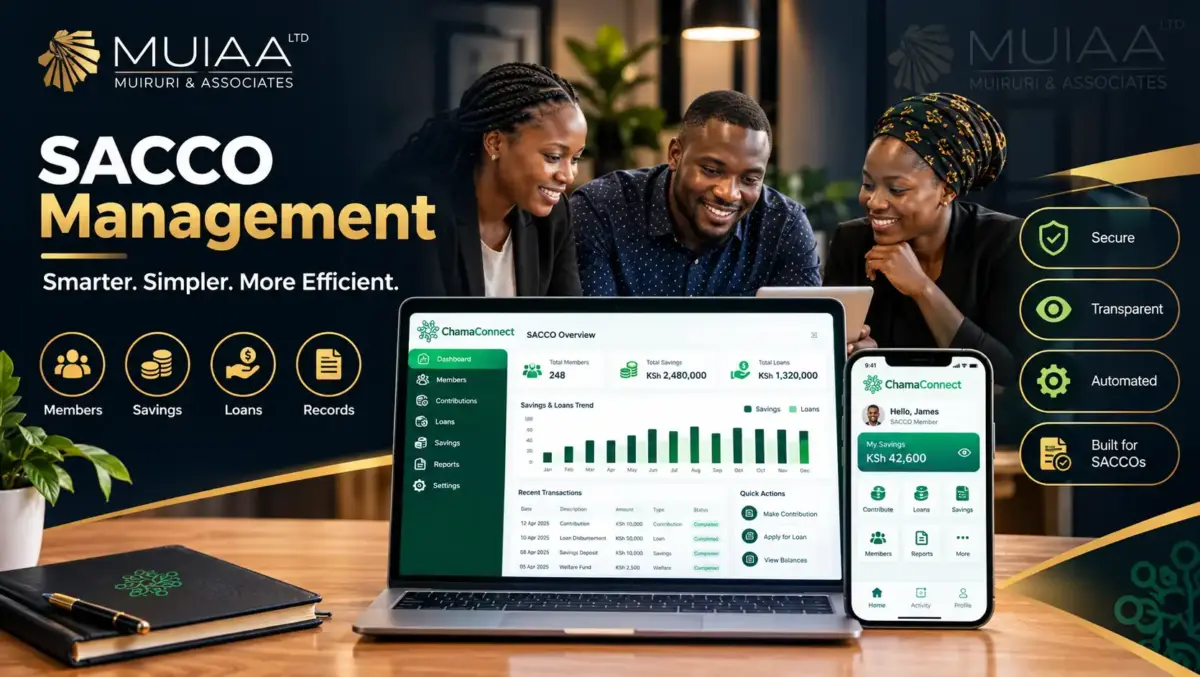





A SACCO can have hundreds or thousands of members, but its daily management often comes down to the same basic things: knowing who belongs to the SACCO, tracking savings, managing loans, recording repayments, approving transactions and keeping reliable financial records.
When those things are handled across separate spreadsheets, paper files, messaging groups and disconnected systems, small gaps can become expensive problems.
A missed entry can affect a member’s balance. A delayed loan update can create confusion. Poorly recorded approvals can make it difficult to establish who authorised a transaction. Over time, the problem becomes bigger than record keeping. It affects trust.
Modern SACCO management is therefore about more than having a computerised system. It is about having clear processes, good controls, reliable records and the right tools to support the people responsible for running the SACCO.
For Kenyan SACCOs, this also sits within a regulated environment. The SACCO Societies Regulatory Authority (SASRA) regulates deposit-taking SACCOs and specified non-deposit-taking SACCOs, while different SACCOs may fall under different regulatory requirements.
This guide looks at what modern SACCO management involves, where the biggest operational challenges occur, and how digital systems can help SACCOs manage their financial and member activities more effectively.
1. What Does SACCO Management Involve?
SACCO management covers the day-to-day work required to run the cooperative, serve members and protect the organisation’s financial and operational interests.
At a practical level, this includes:
- managing members
- recording shares and savings
- receiving contributions
- managing loans
- tracking guarantors
- recording repayments
- managing dividends
- handling welfare funds where applicable
- approving financial transactions
- maintaining financial records
- preparing reports
- managing office-bearer responsibilities
- handling member communication
- monitoring compliance
- maintaining proper audit records
These activities are connected.
A member’s savings can affect their borrowing ability. A loan affects the member’s outstanding balance. A repayment changes the loan position. Guarantor obligations can depend on the outstanding loan. Financial reports depend on all these transactions being recorded correctly.
That is why SACCO management works best when these activities are treated as parts of one system rather than isolated administrative tasks.
2. Why Is Good SACCO Management Important?
A SACCO is different from an ordinary business because members are both users and owners of the cooperative.
SASRA describes a SACCO as a cooperative that provides financial services with a primary focus on mobilising funds and providing affordable credit to members who are both owners and users.
That relationship creates a strong need for accountability.
Members need to know that:
- their contributions are recorded correctly
- their savings balances are accurate
- loans are handled according to approved rules
- repayments are properly reflected
- authorised people control financial activities
- financial records can be reviewed
- reports are based on reliable information
Good management also protects the SACCO itself.
Clear processes make it easier to identify errors, investigate unusual transactions, prepare reports and maintain continuity when office bearers or staff change.
3. What Are the Main Areas of SACCO Management?
A modern SACCO normally has several connected management areas.
3a. Member Management
Every SACCO needs accurate information about its members.
Member management may include:
- registration
- member identification
- contact information
- membership status
- shares
- savings
- loan history
- guarantor obligations
- beneficiary information
- statements
- member communication
The member record becomes the starting point for many other SACCO activities.
If that record is incomplete or outdated, problems can spread into loans, savings, reporting and communication.
For regulated SACCOs, maintaining proper records is also part of the wider accountability framework. Model SACCO by-laws published through the State Department for Cooperatives provide for the maintenance and inspection of member registers and financial records.
3b. Contributions and Savings
Contributions and savings are at the centre of SACCO operations.
The SACCO needs to know:
- who contributed
- how much was contributed
- when it was received
- where it was allocated
- whether the member is up to date
- how the transaction affects the member’s balance
A good process should also make reconciliation easier.
When payments come through different channels, the SACCO needs a reliable way to match each payment to the correct member and account.
3c. Loan Management
Loans are another major part of SACCO management.
A loan process can involve:
Application → Eligibility → Appraisal → Guarantors → Approval → Disbursement → Repayment → Closure
Each stage creates information that needs to be recorded.
Kenyan SACCO regulations require regulated SACCOs to have a written credit policy covering areas such as loan procedures, loan requirements, permissible purposes, collateral, loan limits, interest rates, repayment conditions, approval levels and guaranteeing requirements.
That means loan management isn’t simply about sending money to members.
It involves applying the SACCO’s approved lending rules consistently.
3d. Guarantor Management
Where a SACCO uses guarantors, their obligations need to be tracked alongside the loan.
The SACCO may need to know:
- who guaranteed the loan
- the amount guaranteed
- whether the guarantor has accepted the obligation
- how much of the guarantee remains exposed
- whether the guarantor has other obligations
- when the guarantee can be released
Poor guarantor records can create problems for both borrowers and guarantors.
3e. Repayment Management
After disbursement, the SACCO needs to monitor repayments.
This includes:
- repayment dates
- amounts paid
- principal
- interest
- arrears
- penalties where applicable
- outstanding balances
- completed loans
A repayment system should make it easy for both staff and authorised officials to understand the current position of a loan.
3f. Financial Reporting
Management needs reliable reports to understand what is happening inside the SACCO.
Reports may cover:
- member savings
- contributions
- loans
- repayments
- arrears
- income
- expenses
- assets
- liabilities
- dividends
- financial performance
Reports are only useful when the underlying records are accurate.
A polished report built from incomplete transactions is still a poor report.
3g. Governance and Office-Bearer Management
SACCO management also involves people.
Different officers may have different responsibilities.
A SACCO can have:
- board members
- chairperson
- treasurer
- secretary
- credit committee
- supervisory committee
- chief executive officer
- finance staff
- credit staff
- ICT staff
The exact structure depends on the SACCO.
SASRA’s governance guidance for regulated SACCOs, for example, recognises senior management functions including finance, credit, internal audit, ICT, risk and governance.
The important point is that financial responsibilities shouldn’t depend on one person’s account or password.
There should be defined roles, approval levels and accountability.
4. How Should a SACCO Organise Its Financial Records?
A SACCO should be able to trace a financial activity from the original transaction through to the relevant member record and financial report.
For example:
Member contribution → Member account → SACCO ledger → Reconciliation → Financial report
The same principle applies to loans:
Loan application → Approval → Disbursement → Repayment → Outstanding balance → Loan report
This creates a chain of records.
If one part is missing, staff may have to reconstruct what happened using bank statements, receipts, spreadsheets, emails or messages.
That takes time and creates room for mistakes.
Kenyan SACCO model by-laws provide for books of accounts, financial statements and other records to be maintained and made available for inspection.
For a modern SACCO, good record management should therefore be treated as part of daily operations rather than something prepared only when an audit or meeting is approaching.
5. What Challenges Do SACCOs Face When Managing Operations?
Many SACCO management problems don’t start with a major financial failure.
They start with small operational gaps.
A contribution is recorded late.
A loan repayment isn’t updated immediately.
A member’s details change but one system still has the old information.
A guarantor’s obligation isn’t properly tracked.
Two people maintain different versions of the same spreadsheet.
An approval is given verbally but there is no clear digital record.
A report has to be prepared by combining information from several sources.
Each problem may look small.
Together, they make management harder.
5a. Fragmented Records
When member information, loan information and financial transactions live in different places, staff spend time moving information between systems.
That creates duplicate data and reconciliation work.
5b. Manual Data Entry
Manual entry is vulnerable to:
- typing errors
- duplicate transactions
- missing entries
- incorrect dates
- wrong member references
- delayed updates
The more transactions a SACCO handles, the harder this becomes.
5c. Limited Visibility
Members and officials may not always have the same view of a transaction.
Someone may know that a payment was made while the official record hasn’t yet been updated.
This can lead to disputes.
5d. Weak Approval Tracking
Financial transactions need clear authorisation.
Without a proper approval trail, it can become difficult to determine:
- who approved the transaction
- when it was approved
- what was approved
- whether the person had authority
5e. Reporting Takes Too Long
If reports require staff to combine information from multiple files, reporting becomes a recurring administrative burden.
It can also delay decision-making.
6. How Can SACCOs Improve Their Management Processes?
The first step isn’t buying software.
It is understanding the workflow.
A SACCO should identify how information moves from one stage to another.
For example:
Member joins → contribution is made → balance updates → member becomes eligible for loan → loan is approved → money is disbursed → repayment begins → loan is cleared
Then ask where information is entered, who approves it, what records are produced and where problems occur.
This helps the SACCO identify processes that can be simplified or automated.
6a. Standardise the Rules
The SACCO should have clear policies for:
- membership
- savings
- lending
- guarantors
- repayments
- penalties
- approvals
- withdrawals where applicable
- dividends
- financial reporting
Technology works better when the underlying rules are already clear.
6b. Give People Defined Responsibilities
Each person should know what they can do and what requires another person’s approval.
For example:
| Role | Typical responsibility |
|---|---|
| Treasurer | Financial transactions and financial records |
| Credit team | Loan assessment and recommendations |
| Secretary | Records, meetings and official documentation |
| Board | Policy and oversight |
| Supervisory function | Independent oversight and review |
| Management | Day-to-day administration |
The exact responsibilities should follow the SACCO’s governing documents and applicable regulations.
6c. Keep One Reliable Record
A SACCO shouldn’t have to ask which spreadsheet contains the latest member balance.
The system of record should be clear.
Every important transaction should have a traceable record.
6d. Separate Data Entry From Approval Where Necessary
For higher-risk financial activities, the person entering or initiating a transaction may not be the same person who gives final approval.
This creates an additional control.
6e. Use Reports as Management Tools
Reports shouldn’t exist only for annual meetings.
Management can use them to monitor:
- loan arrears
- contribution performance
- member activity
- outstanding loans
- financial performance
- unusual transactions
That turns reporting into part of day-to-day management.
7. What Role Does Technology Play in Modern SACCO Management?
Technology can bring these processes together.
A SACCO management system can provide a shared environment for:
- member records
- contributions
- savings
- loans
- guarantors
- repayments
- reports
- notifications
- approvals
- financial activity
Instead of maintaining separate records for every process, the SACCO can connect them.
A member’s loan history can sit alongside their savings information.
A repayment can update the loan record.
A financial transaction can appear in the relevant report.
An authorised officer can review the activity without asking another staff member to search through files.
This is where digital SACCO management becomes more than simply replacing paper with a computer.
The system changes how information moves through the organisation.
8. What Should a SACCO Look for in a Digital Management System?
Not every SACCO needs the same system.
A small SACCO may have very different requirements from a large regulated institution.
But there are several areas worth evaluating.
8a. Member Management
The system should provide a reliable member record and allow authorised users to manage membership information.
8b. Contributions and Savings
It should track contributions and savings accurately and make member balances easy to understand.
8c. Loan Management
Look for support for:
- applications
- approvals
- guarantors
- disbursement
- repayment schedules
- arrears
- loan reports
8d. Role-Based Access
Different users should have access based on their responsibilities.
A treasurer shouldn’t automatically have the same permissions as every other user.
8e. Audit and Activity Records
Important financial and administrative actions should leave a record.
This makes it easier to investigate problems and review activity.
8f. Reporting
Reports should be generated from the same underlying records used to manage members and transactions.
8g. Payment Integration
Where appropriate, the system should connect with the payment channels the SACCO actually uses.
The integration should reduce manual reconciliation rather than simply create another place to check.
8h. Data Security
A SACCO holds sensitive member and financial information.
Security should therefore include access controls, authentication, appropriate permissions, backups and clear data-management practices.
9. How Does Blockchain Fit Into Modern SACCO Management?
Blockchain is one technology that can support selected SACCO processes.
But it shouldn’t be treated as the definition of modern SACCO management.
The basic management work still comes first:
Members → Savings → Loans → Repayments → Records → Reports → Governance
Blockchain can sit underneath some of these processes where a shared, tamper-evident transaction record or programmable rules provide a genuine benefit.
That’s the distinction covered in our Blockchain for SACCOs article.
It also explains why blockchain-based loan management, smart contracts, governance and auditing deserve their own supporting discussions.
For example, a smart contract could help enforce a predefined loan condition.
A blockchain-backed audit trail could help preserve evidence of selected transactions.
But the SACCO still needs proper policies, people, controls and management systems.
Technology supports the operating model. It doesn’t replace it.
10. How Is SACCO Management Moving From Manual to Digital?
The shift usually happens in stages.
A SACCO may begin with paper records.
Then it introduces spreadsheets.
Later, it adds accounting software, a core SACCO system, mobile banking or other digital tools.
The challenge is that adding more tools doesn’t automatically create one connected system.
The better approach is to map the full workflow and identify where systems should connect.
For example:
Member registration
↓
Member account
↓
Contributions and savings
↓
Loan eligibility
↓
Loan application
↓
Approval and guarantors
↓
Disbursement
↓
Repayment
↓
Financial reporting
Each stage should produce information that the next stage can use.
That is where integrated SACCO management software becomes useful.
11. What Does Good SACCO Management Look Like?
A well-managed SACCO should make it relatively easy to answer basic questions about its operations.
How many active members are there?
How much has each member saved?
Which loans are outstanding?
Which loans are in arrears?
Who guaranteed a particular loan?
What repayments have been received?
Who approved a transaction?
What financial activity happened during a particular period?
Can the information be traced back to the underlying transaction?
If answering these questions requires searching through several files and asking different people for records, the management process has room for improvement.
Good management creates a reliable path from activity to record to report.
12. SACCO Management Is Also About Trust
Technology can make records easier to manage, but trust comes from more than software.
Members trust a SACCO when they can see that rules are applied consistently, financial activity is controlled, records are maintained and leaders can account for decisions.
That is why governance remains important even when operations become highly digital.
SASRA’s current mandate places emphasis on prudent practices, member protection, financial stability, governance and accountability within the SACCO sector.
A digital system should strengthen those practices.
It shouldn’t become another black box that members and officials don’t understand.
13. Where Does ChamaConnect Fit Into SACCO Management?
This is where the practical side of SACCO digitisation becomes important.
ChamaConnect is designed around the same financial workflows that many savings groups and cooperative-style organisations need to manage: members, contributions, loans, financial activity, roles, approvals and records.
The platform supports group structures including SACCOs, table banking groups, merry-go-round groups and other savings groups.
For SACCO-style management, the important point isn’t simply that these functions exist.
It’s that they are connected.
A member’s financial activity can be managed alongside their membership record. Loans can be managed alongside guarantors and repayment information. Office-bearer roles can control who is allowed to perform particular actions.
ChamaConnect also provides activity and audit logging for key financial and administrative actions, giving authorised users a record of what happened in the system.
That makes it a practical bridge between the management problems discussed in this article and the digital workflows a SACCO may want to implement.
The blockchain layer comes behind those workflows rather than replacing them. ChamaConnect uses blockchain-backed auditability for selected activity, while the platform itself remains focused on making financial management easier for the people running the group.
14. What Should a SACCO Do Before Digitising Its Management?
Digitisation works better when the SACCO understands its existing operations first.
Start by mapping:
- how members are registered
- how contributions are received
- how savings are recorded
- how loans are assessed
- how guarantors are handled
- how approvals happen
- how repayments are recorded
- how reports are produced
- who has access to financial information
- where errors and delays usually occur
Then identify the processes where digital management would make the biggest difference.
A SACCO doesn’t have to digitise every process at once.
It can start with the areas causing the most administrative work and gradually expand.
15. The Future of SACCO Management in Kenya
SACCO management is becoming increasingly digital.
SASRA itself has continued to invest in digital processes. Its current systems include a portal for non-withdrawable deposit-taking SACCOs that supports registration, returns submission and data analysis. The Authority has also highlighted digitisation, governance, accountability and member protection among its sector priorities.
For SACCOs, the next stage isn’t simply having an app.
It is connecting the different parts of financial management.
Member records should connect with savings.
Savings should connect with loan eligibility.
Loans should connect with guarantors and repayments.
Transactions should connect with reports.
Approvals should connect with accountability.
And the technology supporting all of this should fit the SACCO’s actual size, structure, policies and regulatory obligations.
That is where modern SACCO management is heading.
16. Frequently Asked Questions
16a. What is SACCO management?
SACCO management is the process of running the cooperative’s membership, savings, contributions, loans, repayments, financial records, reporting, governance and daily operations.
16b. What are the main functions of SACCO management?
The main functions include member management, savings and contributions, loan management, guarantor management, repayments, financial reporting, governance, record keeping and compliance.
16c. How can technology improve SACCO management?
Digital systems can centralise member records, automate parts of financial workflows, reduce repetitive data entry, improve reporting, support role-based access and make transaction activity easier to track.
16d. What should a SACCO management system include?
A useful system should ideally support member management, contributions, savings, loans, guarantors, repayments, reporting, user roles, approvals, activity records and appropriate security controls.
16e. Can blockchain be used for SACCO management?
Yes. Blockchain can support selected SACCO processes such as transaction records, audit trails, smart-contract workflows and shared financial records. It should be applied where it solves a specific operational problem rather than used simply because it is available.
16f. Is SACCO management software the same as blockchain?
No. SACCO management software handles the operational work of managing members and financial activities. Blockchain is a technology layer that can support selected functions such as shared records, auditability and programmable transactions.
16g. Can ChamaConnect be used for SACCO management?
ChamaConnect is built to support SACCOs and other savings-group structures with functions such as member management, contributions, loans, financial activity, roles, reporting and related workflows.
16h. Does every SACCO need blockchain?
No. A SACCO should first identify its operational needs. Conventional software may be enough for many processes. Blockchain becomes useful when its specific characteristics provide a meaningful advantage.
17. People Also Search For
- SACCO management
- SACCO management in Kenya
- how to manage a SACCO
- SACCO management system
- SACCO management software
- SACCO financial management
- SACCO loan management
- SACCO member management
- SACCO record keeping
- digital SACCO management
- SACCO accounting
- SACCO contributions management
- SACCO loan management software
- SACCO software Kenya
- SACCO digital transformation
18. Conclusion
Running a SACCO well requires more than collecting savings and issuing loans.
The organisation needs accurate member records, clear lending rules, reliable contribution records, controlled approvals, proper repayment tracking, financial reporting and accountable governance.
When those processes are connected, management becomes easier to understand and easier to control.
Digital systems can help by bringing these activities into one workflow. Blockchain can support selected parts of that infrastructure where shared records, auditability or programmable rules provide a real benefit.
But technology should follow the SACCO’s needs.
A SACCO should first understand its processes, strengthen its policies and identify where manual work creates delays, errors or weak visibility. Then it can choose the digital tools that fit those needs.
For SACCOs moving in that direction, the next question naturally becomes how to digitise specific parts of SACCO management, starting with records, contributions, loans and member management.
That is where the practical digital transformation journey begins.