





Cooperatives run on trust.
Members contribute their money, elect leaders, approve decisions and expect the organisation to manage their shared resources properly. Whether it’s a SACCO, agricultural cooperative, housing cooperative or another member-owned organisation, good governance is what keeps that trust alive.
But governance becomes harder as a cooperative grows.
Records can sit in different offices. Decisions may be recorded in meeting minutes but take time to reach every member. Financial transactions may require several people to verify them. Members can struggle to see how decisions were made or how funds were used.
Technology can help solve some of these problems.
Blockchain is one technology attracting attention because it can create a shared and tamper-evident record of transactions and activities. When used properly, it can strengthen transparency, accountability and record keeping without removing the human leadership that cooperatives depend on.
This is where blockchain governance for cooperatives becomes relevant.
The goal isn’t to put every cooperative activity on a blockchain. The goal is to use blockchain where a shared, verifiable record can make governance stronger.
1. What Is Cooperative Governance?
Cooperative governance is the system used to direct, manage and oversee a cooperative.
It defines who makes decisions, how leaders are elected, how members participate, how money is managed and how leaders are held accountable.
A typical cooperative may have:
- Members
- A general assembly
- An elected board
- Committees
- Management
- Staff
- Auditors
- Other authorised representatives
Each group has different responsibilities.
Members may elect leaders and approve major decisions. The board provides oversight. Management handles day-to-day operations. Auditors review records and controls.
Good governance connects all these roles.
It also creates a clear record of what happened.
For example, if members approve a major investment, the cooperative should be able to show when the decision was made, who participated, what was approved and what happened afterward.
That record becomes particularly important when money is involved.
2. What Is Blockchain Governance?
Blockchain governance refers to the rules, processes and technologies used to manage activities recorded on a blockchain network.
In the cooperative context, this can include recording important transactions, approvals, voting outcomes, membership changes or other governance events in a system where authorised participants can verify the record.
Blockchain works by maintaining records across a distributed network rather than relying entirely on one central database.
Once information is properly recorded and confirmed, changing historical records becomes difficult without detection, depending on the blockchain design and permissions used.
This creates an important governance benefit.
The record becomes easier to verify.
A cooperative could, for example, maintain a blockchain-backed record showing that a particular transaction was approved by an authorised officer at a specific point in time.
The blockchain doesn’t decide whether the transaction was a good decision.
It helps preserve evidence of what happened.
That distinction matters.
3. Why Blockchain Governance Matters for Cooperatives
Cooperatives already have governance structures. The challenge is making those structures work effectively as organisations become larger and more complex.
Blockchain can support several areas.
3a. Better transparency
Members can have greater confidence when important records can be independently verified.
3b. Stronger accountability
Actions by authorised users can be recorded, creating a clearer audit trail.
3c. Better record keeping
Important transactions and approvals can have a consistent digital history.
3d. Reduced disputes
A reliable record can help resolve disagreements about when an action happened or who authorised it.
3e. Improved oversight
Auditors, boards and authorised officials can have better access to transaction histories.
These benefits don’t happen simply because a cooperative adopts blockchain.
The system still needs good governance rules, access controls and responsible people.
Technology supports governance. It doesn’t replace it.
4. How Blockchain Can Improve Cooperative Transparency
Transparency is one of the biggest areas where blockchain can help.
In a traditional system, records may be stored in spreadsheets, paper files, accounting systems, emails and different databases.
This can create gaps.
One person may have the latest contribution records while another has the updated loan information. Meeting decisions may exist in minutes without being connected to the transactions they authorised.
A blockchain-backed system can create a stronger connection between important activities.
For example, imagine a cooperative approves a loan.
The system could record:
- The loan application
- The approval
- The authorised decision-maker
- The approved amount
- The repayment schedule
- Subsequent repayments
- Relevant adjustments
Instead of treating each record as an isolated event, the system can create a traceable history.
That makes it easier to follow the lifecycle of the transaction.
5. Blockchain and Member Participation
Cooperative governance depends on member participation.
Members need access to enough information to understand what is happening within their organisation.
A digital governance platform could give members appropriate visibility into areas such as:
- Their contributions
- Savings
- Loans
- Repayments
- Approved group decisions
- Meeting outcomes
- Membership status
- Other information they are authorised to access
Blockchain can strengthen the underlying record behind these systems.
This is especially useful where members don’t directly control the cooperative’s financial records.
Instead of relying entirely on verbal explanations, members can interact with a system that provides a structured history of relevant activities.
The level of visibility should still depend on the cooperative’s rules and privacy requirements.
Not every member needs access to every record.
Good governance means providing the right information to the right people.
6. Blockchain and Cooperative Decision-Making
Decision-making is another area where blockchain technology can play a role.
Consider a cooperative voting on an important proposal.
A digital voting system could record:
- The proposal
- Voting period
- Eligible voters
- Votes submitted
- Voting outcome
- Approval threshold
- Final decision
A blockchain-backed system can help preserve the history of that process.
This can be particularly useful where voting records need to be protected from unauthorised alteration.
However, blockchain doesn’t automatically make voting democratic.
The cooperative still needs rules covering:
- Who can vote
- How voting rights are calculated
- Quorum requirements
- Approval thresholds
- Conflict-of-interest rules
- How disputed votes are handled
The technology records the process.
The cooperative defines the process.
7. Smart Contracts and Cooperative Governance
Smart contracts are programs that automatically execute predefined rules on a blockchain network.
They can be useful when a cooperative has activities that follow clear conditions.
For example, a cooperative could establish a rule that a particular payment is released only after specified approvals have been completed.
Instead of relying on someone to manually check every condition, software can verify the defined requirements and execute the next step.
Potential uses include:
- Membership-related processes
- Approved disbursements
- Contribution rules
- Voting processes
- Dividend calculations
- Loan conditions
- Automated payments
- Escrow arrangements
But smart contracts have limitations.
They only execute the rules they have been programmed to follow.
If the rule is wrong, the software can faithfully execute the wrong rule.
This is why smart contracts should be introduced alongside proper testing, oversight and clearly documented cooperative policies.
8. Blockchain Governance for SACCOs and Cooperative Financial Organisations
SACCOs are particularly relevant to blockchain governance because they manage large amounts of member financial information.
A SACCO may handle:
- Member contributions
- Savings
- Loans
- Loan repayments
- Guarantors
- Dividends
- Penalties
- Withdrawals
- Transfers
- Financial statements
Each transaction contributes to a member’s financial history.
A reliable digital record is therefore important.
Blockchain-backed systems can provide an additional layer of transaction traceability.
For example, when a loan is approved, the system can record the relevant approval event. When a repayment is made, that repayment can be linked to the loan record.
Over time, this creates a more complete financial history.
This can also support auditing.
An auditor doesn’t only need the final balance. They often need to understand how the balance was produced.
A structured transaction trail can make that process easier.
9. Blockchain and Cooperative Leadership
Leadership accountability is central to cooperative governance.
Elected officials and authorised staff often have access to financial systems and sensitive organisational information.
That creates a need for strong controls.
A blockchain-supported governance system can record actions performed by authorised users.
For example:
Treasurer approves payment → system records approval → authorised payment process begins → transaction is recorded.
This creates a history of the action.
If another authorised user later reviews the transaction, they can see the relevant event history.
This doesn’t mean blockchain prevents fraud.
A person can still abuse their legitimate access.
That is why blockchain needs to work alongside:
- Role-based access
- Approval limits
- Separation of duties
- Authentication
- Monitoring
- Auditing
- Internal controls
The strongest system is one where technology and governance reinforce each other.
10. Role-Based Access and Blockchain Governance
Not everyone in a cooperative should have the same access.
A chairperson, treasurer, secretary, auditor and ordinary member have different responsibilities.
A digital governance system should reflect those differences.
For example:
| Role | Possible Access |
|---|---|
| Member | Personal financial records and approved member information |
| Treasurer | Contributions, payments and financial records |
| Secretary | Membership and governance records |
| Chairperson | Oversight and selected approvals |
| Auditor | Relevant financial and audit records |
| Administrator | System configuration based on assigned permissions |
Blockchain can provide the underlying record of authorised actions, while the application layer controls who can perform those actions.
This combination is important.
Blockchain by itself doesn’t know that someone should be a treasurer.
The cooperative’s digital system has to establish that permission.
11. Blockchain Governance and Cooperative Accountability
Accountability becomes easier when actions can be traced.
Suppose a cooperative discovers that a large payment was made incorrectly.
A strong digital system should allow authorised reviewers to trace:
- Who initiated the transaction
- Who approved it
- When it happened
- What rules applied
- Whether another approval was required
- What happened afterward
A blockchain-backed audit trail can help preserve parts of this history.
This can reduce the dependence on scattered documents and manual reconstruction.
For cooperatives with many members and frequent transactions, that can make a significant difference.
12. Public vs Permissioned Blockchain for Cooperatives
Not every cooperative needs a public blockchain.
There are two broad approaches worth considering.
12a. Public blockchain
A public blockchain allows transactions to be verified across an open network.
Its strengths can include transparency and broad verifiability.
However, privacy, transaction costs, scalability and regulatory considerations may make public networks unsuitable for some cooperative activities.
12b. Permissioned blockchain
A permissioned blockchain restricts participation to approved organisations or users.
This can be more appropriate where financial and member information requires controlled access.
A cooperative could potentially allow authorised participants such as auditors, administrators or affiliated organisations to interact with the network according to defined permissions.
The right architecture depends on the use case.
There is no single blockchain model that fits every cooperative.
13. Blockchain Governance and Cooperative Accountability
A major strength of blockchain is the ability to create records that are difficult to alter without leaving evidence.
This can support accountability in areas such as:
Financial transactions
Records can provide a traceable history of payments, contributions and other transactions.
Governance decisions
Important approvals and voting events can have a permanent digital record, depending on the system design.
User activity
Actions performed by authorised users can be logged and reviewed.
Audit processes
Auditors can use transaction histories to understand how records were created and changed.
This can improve confidence among members and other stakeholders.
But accountability still requires people to review the records.
A permanent record of a bad decision doesn’t make the decision good.
14. Challenges of Blockchain Governance for Cooperatives
Blockchain has potential, but cooperatives should approach adoption carefully.
14a. Cost
Building, integrating and maintaining blockchain systems can require significant investment.
14b. Technical complexity
Board members, managers and ordinary members may not understand blockchain technology.
The user experience therefore needs to hide unnecessary technical complexity.
Members shouldn’t need to understand cryptographic hashes to use their cooperative’s financial system.
14c. Data privacy
Cooperatives handle sensitive member and financial information.
Putting information on a blockchain requires careful consideration of what should be recorded, who can access it and whether the information can be removed or corrected.
14d. Integration
A cooperative may already use accounting software, mobile money, banking platforms or other systems.
A blockchain solution needs to work with these systems rather than create another isolated database.
14e. Governance risks
Poorly designed blockchain systems can introduce new problems.
If access permissions are badly configured, authorised users may have too much power.
If smart-contract rules are poorly written, automated processes can produce incorrect outcomes.
14f. Skills
Cooperatives may need people who understand both cooperative operations and digital technology.
Technology adoption without proper training can create more confusion rather than less.
15. Blockchain Governance Does Not Replace Cooperative Governance
This is perhaps the most important point.
Blockchain cannot replace elected leadership.
It cannot replace audits.
It cannot replace laws and regulations.
It cannot decide whether a cooperative’s policies are fair.
It cannot determine whether members are being represented properly.
Those remain governance responsibilities.
Blockchain is infrastructure.
Think of it as a stronger record-keeping and verification layer that can support existing governance processes.
The cooperative still needs clear rules, responsible leadership and active members.
16. Blockchain Governance vs Traditional Cooperative Governance
| Area | Traditional Approach | Blockchain-Supported Approach |
|---|---|---|
| Record keeping | Paper, spreadsheets and databases | Digital records with blockchain-backed verification |
| Transaction history | Depends on system records | Can provide a tamper-evident history |
| Approvals | Manual or system-based | Can be digitally recorded and automated |
| Voting | Paper or digital platforms | Can include verifiable digital voting records |
| Auditing | Review of existing records | Review supported by traceable transaction history |
| Transparency | Depends on reporting | Can improve access to verifiable records |
| Automation | Limited or application-based | Can include smart-contract automation |
| Access control | Organisational policies | Policies combined with digital permissions |
The blockchain-supported model isn’t automatically better in every situation.
Its value depends on whether it solves a real governance problem.
17. A Practical Example of Blockchain Governance in a Cooperative
Consider a Kenyan agricultural cooperative with hundreds of members.
The cooperative collects member contributions, issues loans and makes payments to suppliers.
Previously, records were spread across spreadsheets, receipts and accounting software.
The board wants better visibility.
The cooperative introduces a digital system with blockchain-backed transaction records.
A member makes a contribution.
The transaction enters the system.
The contribution is associated with the member’s account and recorded in the transaction history.
Later, the member applies for a loan.
The application goes through the cooperative’s approval process.
Once approved, the system records the decision and creates the loan repayment schedule.
Each repayment is then recorded against the loan.
If the auditor reviews the loan six months later, there is a digital trail showing the major events in its lifecycle.
The technology hasn’t made the cooperative’s leaders unnecessary.
It has made the cooperative’s records easier to trace.
That is the real governance benefit.
18. How Blockchain Can Support Cooperative Audits
Auditing depends heavily on reliable records.
Auditors need to establish whether transactions are complete, authorised and accurately recorded.
Blockchain can help by creating an additional layer of transaction history.
For example, an auditor could review the sequence of events around a transaction rather than relying only on a final database value.
This can help identify unusual activity.
A transaction that appears normal today may look very different when its history is examined.
The cooperative can also establish different access levels for auditors and internal reviewers.
This makes it possible to give auditors the information they need without giving them operational control over the system.
19. The Role of Digital Identity in Cooperative Governance
Blockchain governance can also connect with digital identity.
Cooperatives need to know who their members are and who is authorised to act on behalf of the organisation.
A strong digital identity system can connect actions to verified users.
For example:
Member identity → membership record → voting rights → transaction history
Or:
Treasurer identity → authorised role → payment approval → audit record
This creates a stronger connection between a person’s role and their actions.
Digital identity therefore becomes an important part of blockchain-based governance.
20. Blockchain Governance and Member Trust
Trust is difficult to build and easy to lose.
Members may tolerate an occasional administrative mistake.
They are less likely to tolerate unexplained financial transactions or decisions that appear hidden from them.
Greater visibility can therefore strengthen the relationship between members and cooperative leadership.
When members can access accurate information about their own accounts and understand important decisions, they have a stronger basis for participation.
Blockchain can support this by making important records easier to verify.
But trust still depends on human behaviour.
A transparent system cannot compensate for dishonest leadership.
It can, however, make dishonest or unauthorised activity harder to hide.
21. How Cooperatives Can Prepare for Blockchain Adoption
A cooperative doesn’t need to move everything to blockchain at once.
A better approach is to identify specific problems first.
Start with areas where there is:
- Frequent disagreement over records
- Heavy manual reconciliation
- Multiple approval stages
- High transaction volumes
- Poor audit trails
- A need for shared verification
- Complex member records
Then assess whether blockchain actually solves the problem.
The cooperative should also establish:
- Clear governance rules
- User roles and permissions
- Data protection requirements
- Audit requirements
- Integration requirements
- Member communication and training
- A process for correcting genuine errors
- A clear responsibility structure
Technology should follow the governance need.
Not the other way around.
22. Blockchain Governance in the Kenyan Cooperative Sector
Kenya has a large and diverse cooperative sector covering areas such as savings and credit, agriculture, housing, transport and other economic activities.
Many of these organisations manage large volumes of member transactions.
Digital transformation can therefore have practical value.
The opportunity isn’t simply to introduce blockchain because it is a new technology.
The bigger opportunity is to solve problems that cooperatives already face.
These include fragmented records, manual reconciliation, slow reporting, limited visibility and difficulties tracking financial activity.
Blockchain becomes useful when it can provide a stronger foundation for solving these problems.
That could mean blockchain-backed audit trails, digitally verifiable approvals, automated workflows or shared records between authorised parties.
The technology should serve the cooperative’s needs.
23. How MUIAA Is Exploring Blockchain-Based Financial Infrastructure
MUIAA’s work in blockchain focuses on practical financial applications rather than treating blockchain as a technology that exists for its own sake.
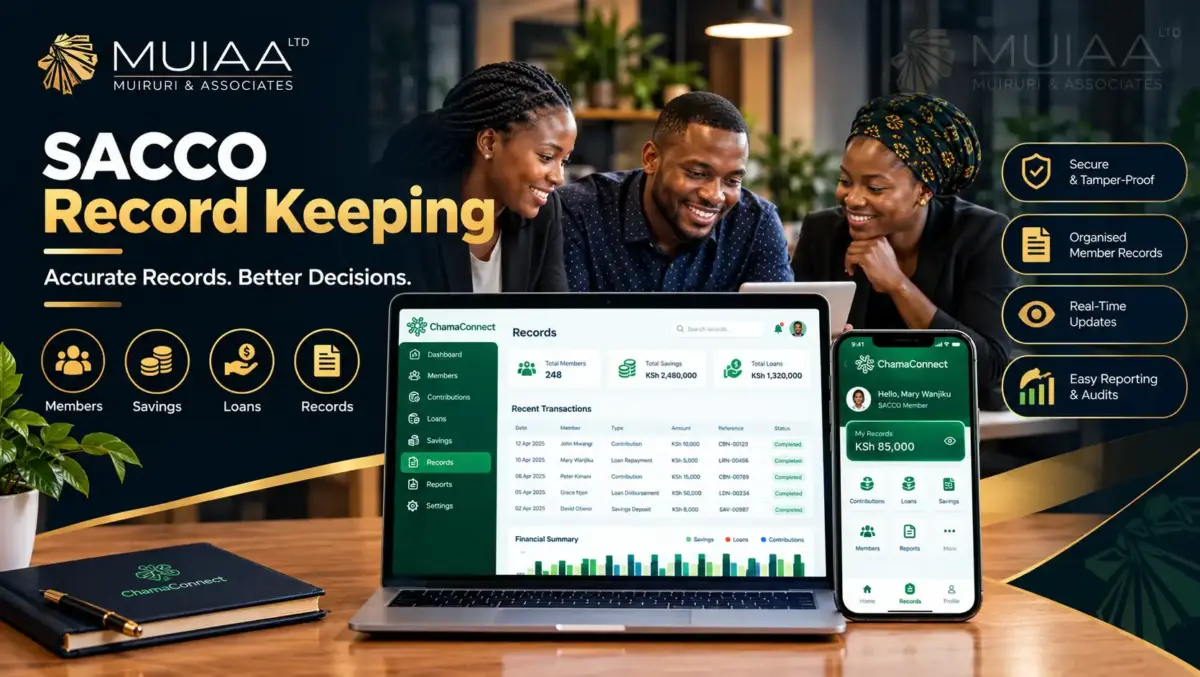
One example is ChamaConnect, a blockchain-powered financial management platform designed for savings groups and SACCOs.
The platform brings together areas such as membership management, contributions, loans, welfare, goals, payments, notifications, reporting and activity tracking.
Its approach is important because the member doesn’t need to interact directly with complicated blockchain infrastructure.
The technology works behind the scenes to support financial records and auditability.
This is a useful direction for cooperative technology.
Members care about knowing their contributions are recorded correctly. Treasurers care about accurate records. Leaders need oversight. Auditors need traceability.
The blockchain layer is valuable when it helps deliver those outcomes.
That is where blockchain governance can move from theory into practical financial infrastructure.
24. The Future of Blockchain Governance for Cooperatives
Blockchain governance is likely to become more relevant as cooperative organisations move further into digital financial systems.
Future systems may combine several technologies.
Blockchain can provide transaction verification and audit trails.
Artificial intelligence can help identify unusual transaction patterns.
Digital identity can connect users with their authorised roles.
Mobile money and banking integrations can connect digital cooperative systems with real financial transactions.
Smart contracts can automate selected processes.
The result could be a cooperative where important financial and governance activities are easier to track from beginning to end.
But the foundation will remain the same.
Cooperatives will still need good leaders, active members, clear rules and proper oversight.
Technology can strengthen those foundations.
It can’t build them from nothing.
25. Frequently Asked Questions About Blockchain Governance for Cooperatives
25a. What is blockchain governance for cooperatives?
Blockchain governance refers to using blockchain-based systems to support cooperative decision-making, record keeping, transaction tracking, approvals, voting and accountability.
25b. How can blockchain help cooperatives?
Blockchain can help create verifiable transaction histories, strengthen audit trails, support transparency and automate selected processes.
25c. Can blockchain prevent fraud in cooperatives?
No. Blockchain can make records harder to alter without detection, but it doesn’t eliminate fraud. Strong internal controls, access management and auditing are still required.
25d. Can blockchain be used by SACCOs?
Yes. Potential applications include loan records, contributions, repayments, approvals, member records and audit trails.
25e. What are smart contracts in cooperative governance?
Smart contracts are software programs that automatically execute predefined rules. They can be used for selected cooperative processes such as approvals, payments or other rule-based transactions.
25f. Does blockchain replace cooperative leaders?
No. Blockchain is a technology infrastructure. It doesn’t replace boards, managers, members, auditors or other governance structures.
25g. Is a public blockchain suitable for a cooperative?
Not necessarily. A public blockchain may provide broad transparency, but privacy, cost and regulatory considerations can make permissioned or hybrid approaches more suitable.
25h. Can blockchain improve cooperative transparency?
It can. Blockchain-backed records can provide a more traceable history of selected transactions and governance activities.
25i. Can blockchain be used for cooperative voting?
Yes. Blockchain can support digital voting systems by recording votes or voting outcomes in a verifiable way. The cooperative still needs clear voting rules.
25j. What are the main challenges of blockchain for cooperatives?
Common challenges include cost, technical complexity, privacy, integration, skills, governance design and member education.
25k. Is blockchain necessary for every cooperative?
No. A cooperative should adopt blockchain only where it solves a real problem better than simpler technologies.
25l. How does blockchain improve auditing?
A blockchain-backed transaction history can give auditors a clearer trail of relevant activities, making it easier to trace transactions and approvals.
25m. Can blockchain records be changed?
Blockchain records are designed to make unauthorised alteration difficult and detectable. However, the exact level of immutability depends on the blockchain architecture and application design.
25n. How does blockchain support accountability?
It can associate actions with authorised users and create a traceable history of transactions, approvals and other activities.
25o. What is the future of blockchain in cooperatives?
Blockchain is likely to become part of broader digital financial systems that combine digital identity, mobile payments, automation, analytics and secure transaction records.
26. People Also Search For
- blockchain for cooperatives
- blockchain governance
- cooperative governance
- digital cooperative governance
- blockchain for SACCOs
- blockchain in SACCOs
- SACCO management technology
- digital SACCO management
- cooperative management systems
- blockchain financial services
- blockchain transparency
- blockchain audit trail
- smart contracts for cooperatives
- blockchain voting systems
- digital voting for cooperatives
- cooperative financial management
- blockchain in Kenya
- blockchain technology in Kenya
- digital transformation of cooperatives
- cooperative accountability systems
27. Conclusion
Good cooperative governance depends on something simple: members need to trust the system managing their shared resources.
That trust becomes harder to maintain when records are fragmented, decisions are difficult to trace and financial activity depends heavily on manual processes.
Blockchain can help address some of these weaknesses.
It can provide stronger transaction histories, support verifiable records, improve auditability and automate selected governance processes.
But blockchain isn’t a replacement for good leadership.
The most useful approach is to combine technology with clear rules, strong controls and active member participation.
For cooperatives, the future of blockchain isn’t necessarily about putting everything on a blockchain.
It’s about using the technology where it creates a better record, a clearer process and greater accountability.
That is the real opportunity for blockchain governance in the cooperative sector.
MUIAA is exploring this practical side of blockchain through financial technologies such as ChamaConnect, where secure digital records, automation and transparency are designed around the everyday needs of savings groups and cooperative financial organisations.
For this kind of news, articles, tutorials and more, visit us at MUIAA Ltd where we offer research, advice and build modern day innovations in blockchain, fintech, and digital finance across emerging markets. We help turn ground-level realities into practical financial tools.