





SACCOs have always depended on one thing when it comes to lending: reliable records.
A member applies for a loan. The SACCO assesses the application, checks eligibility, considers guarantors, approves the loan, disburses the money and then tracks repayments until the loan is cleared.
That sounds straightforward.
For a growing SACCO with hundreds or thousands of members and many active loans, it becomes a much bigger operation.
There are loan applications to process, guarantors to track, repayments to reconcile, interest to calculate and records to maintain. Members also expect faster services and clearer access to their financial information.
This is where blockchain loan management can become useful.
Blockchain doesn’t replace a SACCO’s lending policies or credit officers. It provides another layer of technology for recording, verifying and potentially automating parts of the lending process.
For SACCOs exploring digital transformation, that distinction matters.
1. How SACCO Loan Management Works
A SACCO loan goes through several stages before it reaches the member’s account.
The exact process varies between SACCOs and loan products, but the basic workflow usually includes:
- Loan application.
- Member eligibility assessment.
- Credit assessment.
- Guarantor or security checks.
- Approval.
- Disbursement.
- Repayment.
- Monitoring.
- Loan closure.
Each stage creates information that needs to be recorded correctly.
If one part of the record is missing or inaccurate, it can affect everything that follows.
1a. Member Loan Application
The process begins when a member requests a loan.
The SACCO needs to capture information such as:
- Member identity.
- Loan type.
- Amount requested.
- Purpose.
- Repayment period.
- Existing loans.
- Relevant security or guarantor information.
The application becomes the starting point for the loan record.
1b. Loan Assessment
The SACCO then determines whether the member qualifies.
Depending on the SACCO and loan product, this can involve looking at:
- Savings.
- Previous borrowing.
- Repayment history.
- Income.
- Existing obligations.
- Guarantors.
- Available security.
- Loan limits.
This stage usually requires human judgement, even when software supports the process.
1c. Loan Approval
Once the assessment is complete, the application moves through the appropriate approval process.
The SACCO needs a reliable record of:
- The approved amount.
- Approval date.
- Approval authority.
- Interest terms.
- Repayment period.
- Conditions attached to the loan.
1d. Loan Disbursement
After approval, the funds are released to the member.
The system should connect the disbursement to the original loan application and approval.
That creates a complete record from request to payment.
1e. Repayment and Loan Closure
The final stage can last several months or years.
Each repayment needs to be recorded against the correct loan.
The SACCO should be able to see:
- Amount repaid.
- Principal outstanding.
- Interest outstanding.
- Overdue amounts.
- Repayment dates.
- Remaining instalments.
When the loan is fully paid, the record should clearly show that it has been closed.
2. Common Problems in SACCO Loan Management
Digital systems have already improved many SACCO processes, but loan management can still present challenges.
2a. Manual Records
Paper-based records take time to maintain and are difficult to search.
A SACCO may have to consult several documents to reconstruct the history of one loan.
2b. Disconnected Systems
A loan application might sit in one system while payments, member information and guarantor records are managed somewhere else.
This creates reconciliation work.
2c. Guarantor Tracking
Guarantor commitments can become complicated when members guarantee several loans.
The SACCO needs to know the member’s existing obligations before accepting another guarantee.
2d. Repayment Reconciliation
A SACCO may receive payments through different channels.
Each payment needs to be matched with the correct member and loan.
2e. Record Changes
Financial records sometimes need corrections.
The problem is knowing what changed, who changed it and when.
A system that simply overwrites the previous value can make historical reconstruction difficult.
2f. Limited Member Visibility
Members increasingly expect digital access to their loan information.
They want to know their balance, repayment history and outstanding obligations without waiting for a statement from the office.
3. What Is Blockchain Loan Management?
Blockchain loan management refers to using blockchain infrastructure to record, verify and potentially automate parts of the loan lifecycle.
A blockchain is a distributed digital ledger.
Instead of relying entirely on a conventional database controlled by one organisation, blockchain technology can maintain records across a network according to defined rules.
Transactions recorded on a blockchain are linked cryptographically, making unauthorised alteration more difficult to hide.
For SACCO lending, this can support a more verifiable record of what happened throughout the loan lifecycle.
The important distinction is that blockchain is the underlying technology, not the lending policy.
The SACCO still decides:
- Who qualifies.
- How much members can borrow.
- What interest rate applies.
- What security is required.
- Who approves loans.
- What happens when a member defaults.
Blockchain can help record and enforce certain rules. It doesn’t decide what those rules should be.
4. How Blockchain Can Be Used in SACCO Lending
Blockchain can potentially support several points in the lending process.
4a. Recording Loan Applications
A loan application can create a digital record containing relevant information about the request.
The record can establish when the application was submitted and what information was associated with it at that point.
4b. Recording Loan Approvals
The approval can become part of the transaction history.
The system can record:
- Approved amount.
- Date.
- Approval status.
- Relevant conditions.
- Authorised approval activity.
This creates a clearer history than relying on a document that can be replaced later.
4c. Recording Disbursements
Once funds are released, the disbursement can be linked to the approved loan.
This helps connect the approved amount with the amount actually issued.
4d. Recording Repayments
Each repayment can become part of the loan’s transaction history.
Over time, the SACCO builds a complete record of the loan.
4e. Maintaining Loan History
A blockchain-backed record can provide a chronological history of relevant transactions.
This can help answer questions about what happened to a loan and when.
4f. Creating an Audit Trail
A properly designed blockchain system can make it easier to establish the history of important transactions.
That can be useful for internal controls, audits and dispute resolution.
5. Blockchain and SACCO Loan Transparency
Transparency is one of the strongest potential benefits of blockchain.
Consider a loan approved for KSh 500,000.
The SACCO needs to know:
- When it was approved.
- Who approved it.
- When it was disbursed.
- How much has been repaid.
- What remains outstanding.
- Whether payments were made on time.
- Whether any relevant records were changed.
A blockchain-backed system can provide a verifiable transaction history.
This doesn’t mean every member sees every transaction.
Access still needs to be controlled according to the SACCO’s governance and privacy requirements.
The value comes from authorised users being able to verify the relevant record.
5a. Blockchain Doesn’t Mean Everything Is Public
There’s a common misunderstanding that blockchain automatically means financial information is visible to everyone.
That’s not necessarily the case.
A blockchain implementation can be designed with access controls and appropriate privacy mechanisms.
A SACCO needs to determine:
- Who can view information.
- Who can submit transactions.
- Who can approve activities.
- What information should remain private.
- What records need to be independently verifiable.
For financial institutions, these design decisions matter as much as the blockchain itself.
6. Smart Contracts and SACCO Loans
Smart contracts can add another layer of automation.
A smart contract is software deployed on a blockchain that executes predefined rules when specified conditions are met.
In SACCO lending, this could potentially be used for certain predictable processes.
6a. Automating Loan Rules
For example, a system could apply rules around:
- Loan limits.
- Eligibility.
- Interest calculations.
- Repayment schedules.
- Penalties.
- Approval conditions.
The SACCO first defines the rules.
The software then applies them consistently.
6b. Automated Repayment Rules
Suppose a loan requires monthly repayments.
The system can track the repayment schedule and record payments against the loan.
If a payment is late, the relevant penalty rule could be triggered automatically if the SACCO’s system has been designed to do so.
Automation reduces repetitive administrative work.
It doesn’t remove the need for oversight.
6c. Human Approval Still Matters
Some lending decisions shouldn’t be reduced to software rules.
A member might have an unusual application.
A guarantor might dispute an obligation.
A loan might require an exception.
A member might challenge a penalty.
These situations can require human review.
Good digital lending systems should make room for that.
7. Blockchain for SACCO Loan Guarantors
Guarantors are an important part of many SACCO lending models.
The guarantor isn’t simply another name on the application.
They accept a financial responsibility connected to another member’s loan.
That makes guarantor records important.
7a. Recording Guarantees
A digital system can record:
- Borrower.
- Guarantor.
- Loan amount.
- Guaranteed amount.
- Date.
- Status.
This gives the SACCO a clearer picture of the commitment.
7b. Tracking Existing Commitments
Suppose a member is already guaranteeing three loans.
Before accepting another guarantee, the SACCO may need to assess the member’s existing exposure.
A connected digital record makes this easier.
7c. Creating a Verifiable Guarantee History
A complete transaction history can help establish when a guarantee was created and what happened to the associated loan.
This can reduce uncertainty when questions arise later.
8. Blockchain and SACCO Loan Repayments
Repayment management is where the quality of the loan record becomes particularly important.
A SACCO might manage thousands of repayment transactions over a year.
Every one needs to be associated with the correct loan.
8a. Recording Each Repayment
Each payment can be recorded with relevant information such as:
- Member.
- Loan.
- Amount.
- Date.
- Payment reference.
- Payment type.
8b. Updating the Outstanding Balance
The system can use the repayment information to calculate the remaining obligation.
The exact calculation depends on the SACCO’s loan terms.
8c. Tracking Overdue Loans
The repayment history can also help identify loans that are falling behind schedule.
This gives credit and management teams a clearer view of portfolio performance.
8d. Maintaining a Complete History
Instead of simply displaying the current loan balance, a good system should preserve the underlying transaction history.
That makes it easier to understand how the balance was reached.
9. Blockchain and SACCO Credit Management
Blockchain could also play a role in building more reliable digital financial histories.
A member may have years of:
- Savings.
- Loans.
- Repayments.
- Guarantees.
- Defaults.
- Completed loans.
A reliable record of this activity can help the SACCO understand the member’s relationship with the institution.
However, blockchain shouldn’t be confused with credit scoring.
Blockchain records information.
A credit-scoring model interprets information to assess risk.
They can work together, but they’re different functions.
10. Benefits of Blockchain Loan Management for SACCOs
Blockchain isn’t appropriate for every financial process.
Where it fits, however, it can provide several potential advantages.
10a. Better Record Integrity
Blockchain’s cryptographic structure can make unauthorised changes to recorded transactions harder to conceal.
10b. Stronger Audit Trails
A transaction history can provide a clearer record for internal review and auditing.
10c. Greater Transparency
Authorised users can have greater confidence that the information they’re reviewing corresponds to the underlying transaction history.
10d. More Consistent Rules
Smart contracts can apply predefined rules consistently.
This can be useful for calculations and repetitive processes.
10e. Reduced Administrative Work
Automation can reduce repetitive activities such as checking certain conditions, updating records and tracking predefined schedules.
10f. Better Loan Monitoring
A connected record can give SACCO staff a clearer view of active loans, repayments and outstanding balances.
10g. Improved Member Visibility
Digital access can allow members to see relevant information about their own loans without relying entirely on manual statements.
11. Blockchain Doesn’t Solve Every SACCO Lending Problem
This is where discussions about blockchain often become unrealistic.
Blockchain is useful for specific problems.
It isn’t a solution to every problem in SACCO lending.
11a. Blockchain Doesn’t Fix Bad Data
If incorrect information is entered into the system, recording it on a blockchain doesn’t make the information correct.
The system still needs good data controls.
11b. Blockchain Doesn’t Replace Good Governance
A SACCO still needs:
- Clear policies.
- Responsible officials.
- Internal controls.
- Proper approvals.
- Member oversight.
Technology can’t replace these.
11c. Integration Can Be Difficult
A SACCO may already have systems for:
- Member management.
- Accounting.
- Banking.
- Mobile payments.
- Loan processing.
- Reporting.
A blockchain layer needs to work with the systems that are already in use.
11d. Privacy Requires Careful Design
Financial information is sensitive.
A blockchain solution needs appropriate access controls and privacy architecture.
11e. Implementation Requires Expertise
A blockchain system needs proper design, security, testing and maintenance.
Using blockchain simply because it is available doesn’t create value.
The technology should solve a real problem.
12. Traditional SACCO Loan Management vs Blockchain-Supported Management
The difference is easier to understand when viewed across the loan lifecycle.
| Area | Traditional Digital System | Blockchain-Supported System |
|---|---|---|
| Loan application | Stored in database | Can be recorded with verifiable transaction history |
| Approval | Recorded internally | Approval can become part of an auditable transaction history |
| Disbursement | Database record | Can be linked to approved loan record |
| Repayments | Stored in database | Can be recorded as verifiable transactions |
| Guarantors | Separate or linked records | Can be connected to loan records |
| Audit trail | Depends on system design | Transaction history can provide additional verification |
| Automation | Application-level rules | Application rules can work with smart contracts |
| Data changes | Controlled through system permissions | Recorded transactions can make historical changes easier to detect |
| Member access | Depends on platform | Depends on platform and access design |
The important point is that a blockchain system is still a digital system.
The difference lies in how certain records are stored, verified and potentially automated.
13. How Blockchain Could Work With Existing SACCO Systems
A SACCO doesn’t necessarily have to replace every system it already uses.
Blockchain could operate as one layer within a wider technology architecture.
For example:
Member App → SACCO Platform → Blockchain Layer → Verified Transaction Record
Other systems could continue handling their existing functions.
A payment system could process a transaction.
The SACCO platform could identify the member and loan.
The blockchain layer could record a verifiable representation of the relevant transaction.
This type of architecture can be more practical than trying to put every piece of the SACCO’s operations directly onto a blockchain.
13a. Blockchain and M-Pesa
This distinction is particularly relevant in Kenya.
M-Pesa can be used to move money.
Blockchain can be used to record and verify information.
They serve different purposes.
A SACCO could potentially receive a repayment through a mobile-money channel and then record the relevant transaction within a blockchain-supported loan management system.
The payment rail and recordkeeping layer don’t have to be the same technology.
14. What Would a Blockchain-Based SACCO Loan Journey Look Like?
Consider a simplified example.
A member applies for a KSh 300,000 loan.
Step 1: Application
The member submits the application digitally.
Step 2: Eligibility
The system checks the SACCO’s defined lending rules.
Step 3: Guarantors
Required guarantors are recorded and their commitments linked to the application.
Step 4: Approval
An authorised SACCO official approves the loan.
Step 5: Record
The approved loan information is recorded within the relevant digital and blockchain infrastructure.
Step 6: Disbursement
The SACCO releases the approved funds.
Step 7: Repayment
The member makes scheduled repayments.
Step 8: Monitoring
The system updates the loan position and identifies overdue amounts where applicable.
Step 9: Closure
Once the loan is fully repaid, the system records the completed loan.
The result is a connected digital history from application to closure.
15. What SACCOs Should Consider Before Adopting Blockchain
A SACCO shouldn’t start with the question, “How do we put our loans on blockchain?”
A better starting point is identifying the actual problem.
For example:
Are loan records difficult to reconcile?
Are guarantor commitments hard to track?
Does the SACCO need stronger transaction verification?
Are manual processes slowing down loan approvals?
Do members lack visibility into their loan records?
Once the problem is clear, the SACCO can determine whether blockchain is an appropriate part of the solution.
15a. Start With the Loan Lifecycle
Map the current process.
Identify:
- Where applications enter.
- Where approvals happen.
- Where records are stored.
- How repayments arrive.
- How balances are calculated.
- Where reconciliation happens.
- Where disputes occur.
This often reveals the real technology gaps.
15b. Decide What Should Be Automated
Not every process needs automation.
Good candidates are usually predictable and rule-based activities.
For example:
- Calculating scheduled repayments.
- Applying defined penalties.
- Updating balances.
- Recording transactions.
- Generating reports.
Human judgement should remain where exceptions and complex decisions are involved.
15c. Define Access Rights
Determine what each user should be able to see and change.
For example:
Member: personal loan and contribution information.
Loan officer: loan applications and assessments.
Treasurer: financial records and reporting.
Manager: oversight and approvals.
Auditor: appropriate historical records.
The exact structure depends on the SACCO.
16. How MUIAA Is Exploring Blockchain-Based Financial Products
MUIAA’s interest in blockchain goes beyond discussing the technology in theory.
The company is developing blockchain-powered financial products aimed at practical financial management problems.
One example is ChamaConnect, a digital financial management platform developed for savings groups and SACCO-type organisations.
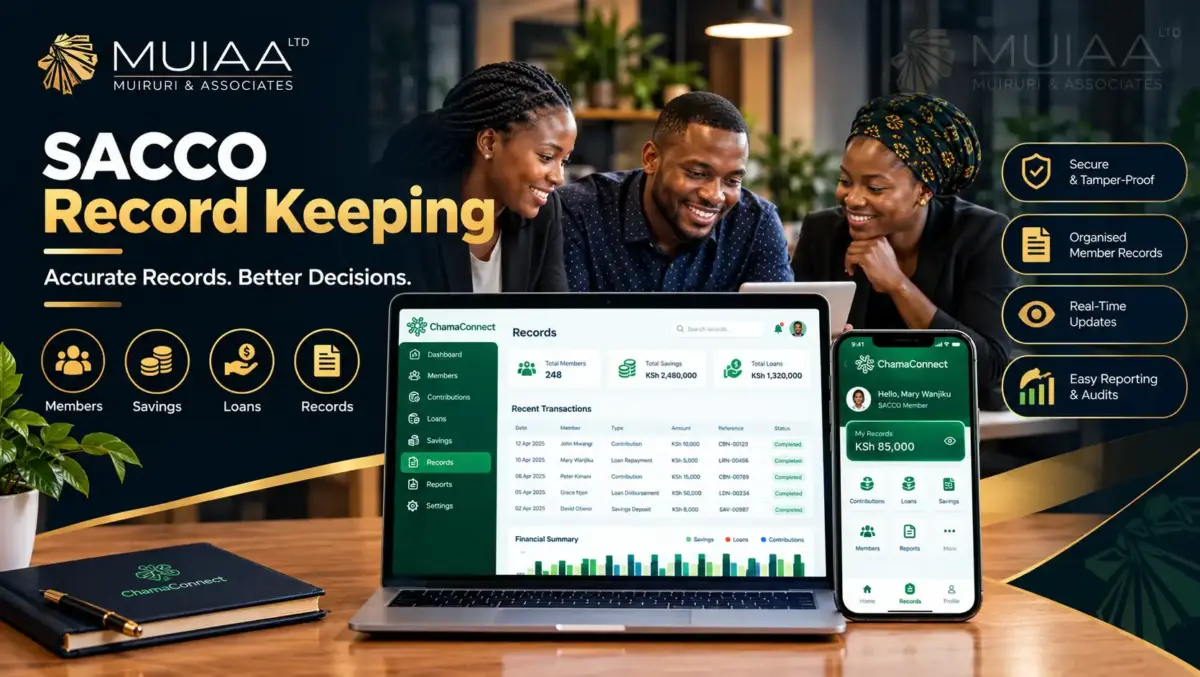
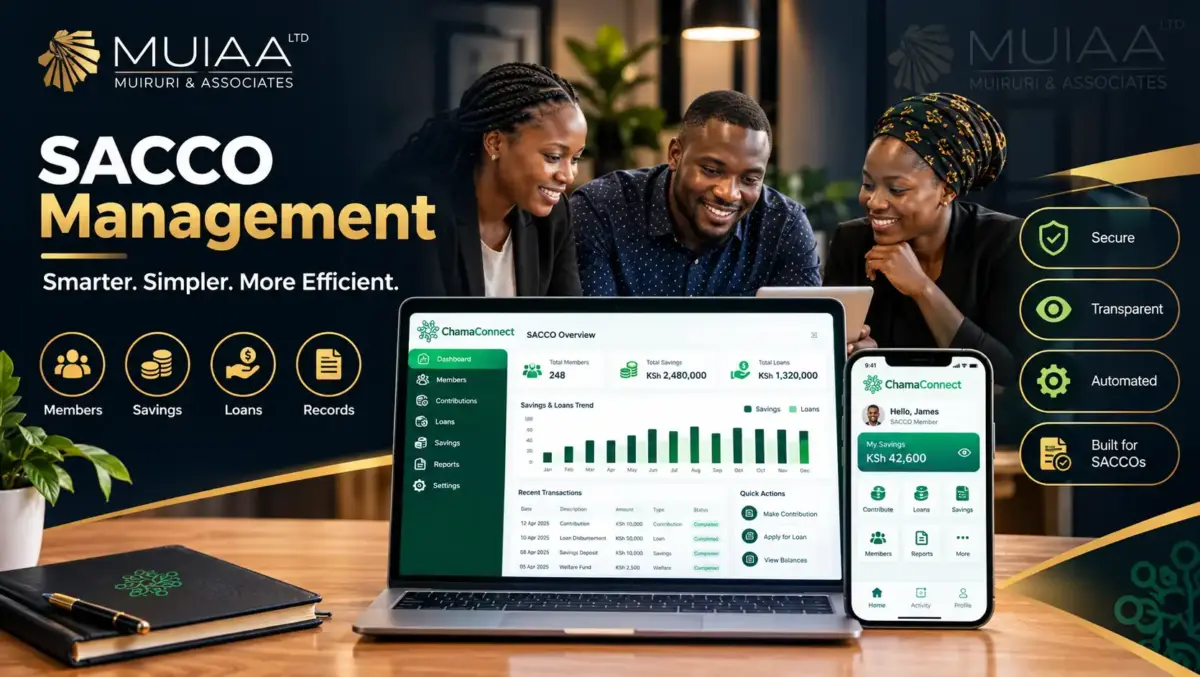
ChamaConnect brings activities such as member management, contributions, savings, loans, guarantors, repayments, welfare and reporting into one digital environment.
The same principle applies to blockchain loan management.
Technology should solve a real financial management problem first.
Blockchain can then provide infrastructure for stronger transaction records, verification and automation where it makes sense.
This approach gives MUIAA a practical reason to explore blockchain in financial services. The focus is on applying the technology to real financial workflows rather than treating blockchain as an end in itself.
17. The Future of Blockchain Loan Management for SACCOs
SACCO lending is becoming increasingly digital.
Members expect faster applications, easier access to information and more convenient repayment options.
SACCOs also need stronger systems as their membership and loan portfolios grow.
Blockchain could become part of that evolution.
Potential applications include:
- Verifiable digital loan records.
- Automated loan rules.
- Smart-contract-based workflows.
- Digital identity.
- Connected guarantor records.
- Automated repayment tracking.
- Improved audit trails.
- Cross-platform financial records.
The technology will probably work best as part of a broader digital ecosystem rather than as a standalone solution.
18. Frequently Asked Questions
18a. What is blockchain loan management?
Blockchain loan management is the use of blockchain infrastructure to record, verify and potentially automate parts of the lending process, including applications, approvals, disbursements and repayments.
18b. How can blockchain help SACCOs?
Blockchain can help SACCOs create verifiable transaction histories, strengthen audit trails, support automation and improve the integrity of certain financial records.
18c. Can blockchain automate SACCO loans?
It can automate certain rule-based activities through smart contracts and connected software. Human oversight is still appropriate for credit decisions, exceptions and disputes.
18d. Can blockchain track SACCO loan repayments?
Yes. Repayments can be recorded as part of a digital transaction history and linked to the relevant loan.
18e. Can blockchain manage SACCO guarantors?
Blockchain can provide infrastructure for recording and verifying guarantor commitments. The SACCO’s software would still manage the business rules around guarantor eligibility and capacity.
18f. Are blockchain loans the same as cryptocurrency loans?
No.
Blockchain is a technology for recording and processing information. Cryptocurrency is a type of digital asset. A SACCO can use blockchain technology without lending or holding cryptocurrency.
18g. Can SACCOs use blockchain without cryptocurrency?
Yes. Blockchain can be used as underlying infrastructure for transaction records and other financial processes without requiring cryptocurrency.
18h. What are smart contracts in SACCO lending?
Smart contracts are blockchain-based programs that execute predefined rules. They can potentially automate certain lending activities such as scheduled payments, eligibility conditions or penalties.
18i. Is blockchain secure for SACCO financial records?
Blockchain can strengthen the integrity and traceability of certain records, but overall security depends on the entire system, including user access, application security, data handling and governance.
18j. Can blockchain integrate with existing SACCO software?
Potentially, yes. A blockchain layer can be designed to work alongside existing member, accounting, payment and loan-management systems.
18k. What are the disadvantages of blockchain for SACCOs?
Potential challenges include implementation costs, technical complexity, integration requirements, privacy considerations, regulatory requirements and the need for specialised expertise.
18l. How can blockchain improve SACCO transparency?
It can provide a verifiable history of relevant transactions, making it easier for authorised users to establish what happened and when.
18m. Can blockchain reduce SACCO loan processing time?
It can help reduce manual work where processes are predictable and can be automated. However, the actual improvement depends on how the complete loan system is designed.
18n. How does blockchain affect SACCO loan records?
Blockchain can provide an additional layer for recording and verifying transactions, helping create a more traceable history of the loan.
18o. Can ChamaConnect be used by SACCOs?
ChamaConnect is designed to support SACCO-type groups alongside other savings-group structures. Its features include member management, contributions, savings, loans, guarantors, repayments and financial reporting.
Conclusion
SACCO lending depends on reliable information.
Every loan creates a chain of events. An application leads to an assessment. An approval leads to a disbursement. A disbursement leads to repayments. Guarantors, interest, penalties and outstanding balances all become part of the record.
As SACCOs become more digital, the quality and integrity of those records become increasingly important.
Blockchain offers one possible way to strengthen that infrastructure.
It can provide verifiable transaction histories, support smart-contract automation and create stronger audit trails for parts of the lending process.
But the technology should serve the SACCO’s needs.
Good lending policies still matter. Credit officers still matter. Governance still matters. Data quality still matters.
For Kenyan SACCOs, the opportunity lies in combining these fundamentals with digital systems that make lending easier to manage and easier to verify.
That’s also the direction MUIAA is taking with its blockchain-powered financial products.
Chama connect is one example of that approach, bringing digital management of savings, contributions, loans, guarantors, welfare and reporting into a platform built around the needs of African savings groups and SACCO-type organisations.
Blockchain is the infrastructure.
Better financial management is the outcome we’re aiming for.
How MUIAA Is Exploring Blockchain Innovation
MUIAA’s interest in blockchain goes beyond understanding the technology.
The broader goal is to explore how blockchain can solve practical problems within financial services and create new opportunities for businesses and consumers in Kenya and Africa.
Trade finance is a natural extension of that work.
The same blockchain infrastructure that can support secure identity, transparent transactions, digital payments, compliance, and financial markets can also support more connected trade.
MUIAA is exploring blockchain-powered financial products that can bring these ideas closer to practical use.
The focus is on building financial solutions around real problems, with security, transparency, automation, and accessibility at the centre.
As African trade becomes increasingly digital, the businesses and financial institutions that can connect payments, identity, financing, and transaction data will have an important role in shaping the next generation of financial services.
For this kind of news, articles, tutorials and more, visit us at MUIAA Ltd where we offer research, advice and build modern day innovations in blockchain, fintech, and digital finance across emerging markets. We help turn ground-level realities into practical financial tools.