

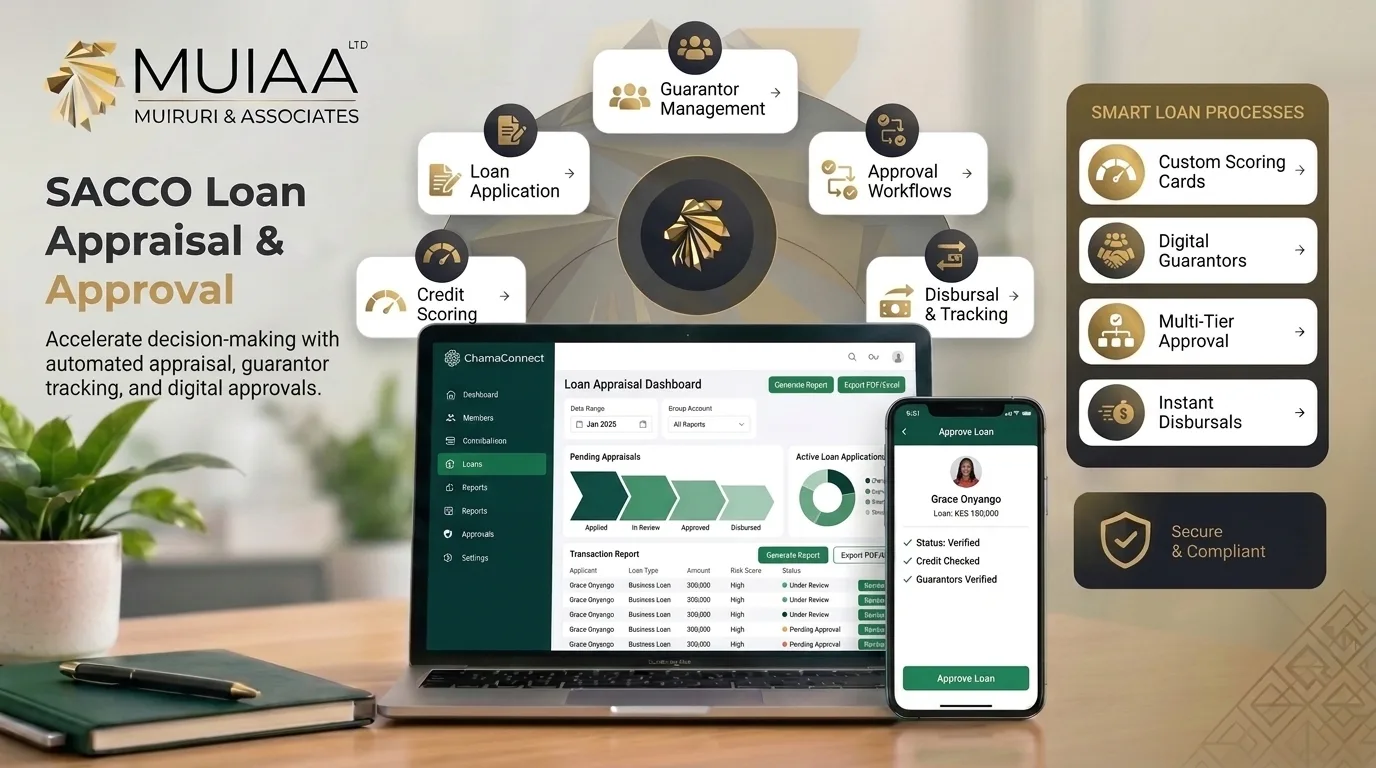





A SACCO can receive dozens of loan applications in a month. Some members need emergency funds. Others want to finance school fees, buy equipment, expand a business or meet personal commitments.
The challenge is deciding which applications the SACCO can responsibly approve.
A good SACCO loan process should protect members while allowing them to access credit. That means looking beyond the amount requested. The SACCO needs to assess repayment capacity, review existing obligations, apply its lending policy, evaluate guarantees where required and document every approval.
This guide explains how SACCO loan appraisal and approval work in Kenya, what lending committees should consider and how SACCOs can improve the quality of their credit decisions.
1. What Is SACCO Loan Appraisal?
SACCO loan appraisal is the process of assessing a member’s application before the SACCO decides whether to approve, adjust or decline the requested loan.
The appraisal helps the SACCO answer five questions:
- Does the member qualify for the loan?
- Can the member repay it within the proposed period?
- Does the requested amount fall within the SACCO’s lending policy?
- Are the proposed guarantors or other security acceptable?
- Can the SACCO approve the loan without taking on unreasonable risk?
Loan appraisal is different from loan approval.
Appraisal assesses the application. Approval is the formal decision made by an authorised person or committee.
The two stages should work together, but they shouldn’t be treated as the same activity.
2. Why SACCOs Need a Clear Loan Appraisal Process
Lending is one of the main services offered by savings and credit cooperatives. Members contribute funds and expect access to credit under agreed terms.
Poor lending decisions can affect the entire SACCO.
For example, approving a loan without checking the borrower’s existing obligations may lead to repayment difficulties. Accepting a guarantee without considering the guarantor’s current commitments can expose another member to unexpected financial responsibility.
A clear appraisal process helps a SACCO:
- Apply lending policies consistently.
- Assess a member’s ability to repay.
- Reduce avoidable loan defaults.
- Protect members who act as guarantors.
- Maintain fair and documented approval decisions.
- Monitor lending exposure across the portfolio.
- Support responsible use of members’ funds.
The objective isn’t to reject more applications. It’s to make lending decisions that the SACCO can explain and support.
3. SACCO Loan Eligibility: Who Qualifies for a Loan?
Loan eligibility refers to the conditions a member must meet before an application can proceed.
Each SACCO should define these conditions in its lending policy and loan products. Requirements may differ depending on the member’s category, loan type, membership history and available security.
Common eligibility considerations include:
3a. Membership Status
The SACCO may require an applicant to be an active member in good standing.
The policy should explain what active membership means and whether a minimum membership period applies.
3b. Savings and Contributions
Some SACCOs use a member’s savings or deposits when determining borrowing limits.
For example, a SACCO may allow a member to borrow a multiple of their qualifying savings, subject to the product rules and other assessment conditions.
The multiple shouldn’t be assumed to be the same across all SACCOs. It should come from the SACCO’s approved lending policy.
3c. Existing Loans
A member may already have one or more outstanding loans.
The SACCO should consider the total outstanding obligation rather than assessing each new application in isolation.
This helps prevent a member from taking on repayments that exceed their financial capacity.
3d. Repayment History
Previous repayment behaviour can provide useful information.
The SACCO may review whether the member has:
- Paid instalments on time.
- Experienced repeated arrears.
- Completed previous loans.
- Requested repayment extensions.
- Maintained other obligations to the SACCO.
A repayment history should inform the assessment, but the SACCO should still consider the member’s current circumstances.
3e. Loan Product Requirements
Different loan products may have different eligibility conditions.
A development loan, emergency loan, school-fees loan and asset-financing loan may require different documentation, limits or repayment periods.
The SACCO should communicate these conditions clearly before members apply.
4. How SACCOs Assess a Borrower’s Ability to Repay
A member may qualify for a loan under the SACCO’s savings-based rules and still struggle to repay it.
That’s why repayment capacity deserves a separate assessment.
The SACCO should consider the member’s expected income, existing financial commitments and the proposed repayment schedule.
4a. Review Income and Cash Flow
The assessment should establish where the member’s repayment money will come from.
For an employed member, this may involve reviewing salary information and existing deductions.
For a business owner or self-employed member, the SACCO may need to understand business income, operating expenses and how regularly money comes in.
The evidence required will depend on the loan product and the SACCO’s policy.
4b. Calculate Existing Financial Commitments
A borrower may have rent, school fees, household expenses, other loans and business obligations.
These commitments affect how much money remains available for loan repayments.
The SACCO should consider the member’s overall position rather than relying on gross income alone.
4c. Check the Proposed Instalment
The proposed instalment should be realistic in relation to the member’s available income.
A loan may look affordable when viewed as a single amount. The monthly or weekly repayment obligation can tell a different story.
The SACCO should assess the full repayment period and the timing of expected income.
4d. Consider Changes in Income
Some members earn irregular income.
A farmer may receive most of their income after a harvest. A small business owner may experience seasonal changes. A contractor may depend on project payments.
A repayment plan should reflect these circumstances where the SACCO’s loan products allow it.
4e. Document the Assessment
The SACCO should retain the information and reasoning behind its decision.
This makes it easier to review the application later, explain a decision to the member and assess whether the lending policy was followed.
5. How SACCOs Determine Loan Amounts and Limits
A loan limit defines the maximum amount a member may qualify for under a particular product or lending policy.
However, the maximum permitted amount isn’t automatically the amount the SACCO should approve.
A member may qualify for a loan of KSh 500,000 under the SACCO’s savings-based formula but only have the capacity to repay KSh 300,000.
The appraisal should therefore consider both the policy limit and the member’s repayment ability.
SACCOs may use several factors when determining loan amounts:
| Assessment factor | What the SACCO considers |
|---|---|
| Qualifying savings | The savings or deposits recognised under the loan policy |
| Existing loans | Current outstanding balances and repayment commitments |
| Repayment capacity | Income available after existing obligations |
| Loan purpose | Whether the requested purpose fits the product |
| Security | Acceptable collateral or guarantees, where required |
| Loan concentration | Exposure to one borrower, sector or related group |
| Product limit | The maximum amount permitted for the loan type |
A sound lending decision should satisfy the SACCO’s policy and make financial sense for the borrower.
6. The Role of Loan Guarantors in SACCO Appraisal
Many SACCOs use guarantors to support member lending.
A guarantor accepts responsibility under the SACCO’s agreed guarantee arrangements if the borrower fails to meet the relevant loan obligations.
This creates a responsibility that needs proper assessment and documentation.
Before accepting a guarantee, the SACCO should consider:
- Whether the guarantor is eligible under the SACCO’s policy.
- Whether the guarantor has consented to the commitment.
- The amount being guaranteed.
- Existing guarantees and other obligations.
- The guarantor’s available savings or other acceptable security.
- The conditions under which the guarantee may be called upon.
6a. Why Existing Guarantees Matter
Suppose a member has already guaranteed two outstanding loans.
The SACCO should review those commitments before accepting another guarantee.
Without a clear record, the SACCO may underestimate the member’s exposure.
6b. Explain the Guarantee Before Approval
Members should understand what they are agreeing to.
A guarantor should know the amount covered, the relevant loan terms and the circumstances under which the guarantee may become enforceable.
The SACCO should maintain evidence of consent and the applicable guarantee documentation.
6c. Review Guarantor Capacity
The SACCO should assess guarantees according to its lending policy and applicable rules.
A guarantor’s savings, existing obligations and other acceptable security may be relevant.
The fact that a member is willing to guarantee a loan doesn’t automatically mean they have sufficient capacity to do so.
7. What Should a SACCO Loan Application Contain?
A loan application should provide enough information for the SACCO to assess the request.
The exact form will depend on the loan product, but a typical application may capture:
| Information | Why it matters |
|---|---|
| Member details | Identifies the applicant |
| Loan product | Establishes the applicable terms |
| Amount requested | Defines the borrowing request |
| Loan purpose | Explains the intended use |
| Repayment period | Establishes the proposed duration |
| Income information | Supports repayment assessment |
| Existing obligations | Shows current financial commitments |
| Guarantor details | Identifies proposed guarantees |
| Supporting documents | Provides evidence for the appraisal |
| Member declaration | Confirms the information submitted |
The SACCO should collect information that is relevant to the lending decision and handle member information appropriately.
8. How SACCO Loan Approval Should Work
Once appraisal is complete, the application should move to the authorised approval level.
The person or committee responsible for approving a loan should have the authority to make that decision under the SACCO’s governance arrangements.
8a. Separate Appraisal From Approval
Where the SACCO’s structure allows, the person assessing an application shouldn’t have unrestricted authority to approve and disburse the same loan.
Separating responsibilities helps reduce conflicts of interest and makes decisions easier to review.
8b. Follow Approval Limits
The SACCO should define who can approve different loan amounts and products.
For example, smaller loans may follow one approval route, while larger or exceptional applications may require committee or board-level consideration.
The actual limits must come from the SACCO’s approved policy.
8c. Record the Decision
The approval record should show:
- Applicant and loan reference.
- Amount requested.
- Amount approved.
- Loan product.
- Repayment period.
- Applicable interest and charges.
- Approval date.
- Authorised decision-makers.
- Conditions that must be met before disbursement.
If an application is declined or returned for additional information, the SACCO should retain the decision and its reason.
8d. Manage Conflicts of Interest
An official who has a personal interest in a loan application should follow the SACCO’s conflict-of-interest procedures.
The approval process should be transparent enough to show who participated and whether the correct procedures were followed.
9. What Kenyan SACCO Regulations Say About Credit Policies
Kenyan SACCOs operate under a legal and regulatory framework that varies according to the nature of their business and regulatory status.
For regulated SACCOs, the SACCO Societies Act and applicable regulations provide requirements for credit management.
The credit-management provisions in the SACCO Societies (Deposit-Taking Business) Regulations address written credit policies. These include loan procedures and documentation, loan requirements, permissible purposes and collateral, concentration limits, interest and repayment conditions, maximum loan sizes, assessment of a borrower’s ability to repay, approval levels and guarantee requirements.
SASRA also publishes risk-management guidance for regulated SACCOs. These materials provide a reference for institutions developing and reviewing their risk-management practices.
SACCOs should confirm which legal and regulatory requirements apply to their specific category. Deposit-taking SACCOs, specified non-deposit-taking SACCOs and other cooperative societies may not all operate under identical requirements.
A practical starting point is to review the SASRA Acts and Regulations directory and obtain professional guidance where necessary.
10. Common Problems in SACCO Loan Appraisal and Approval
Even SACCOs with written lending policies can experience problems when the process isn’t followed consistently.
10a. Approving Loans Based Only on Savings
Savings can help determine eligibility, but they don’t always show whether a member can afford the repayments.
The SACCO should assess repayment capacity separately.
10b. Incomplete Applications
Missing income information, unclear loan purposes or incomplete guarantor details can delay decisions.
A standard application checklist helps reduce repeated follow-ups.
10c. Inconsistent Approval Decisions
If similar applications receive different treatment without a clear reason, members may question the fairness of the process.
Documented criteria and approval records help promote consistency.
10d. Weak Guarantor Checks
Accepting guarantees without checking existing commitments can expose members and the SACCO to avoidable risk.
10e. Poor Documentation
If the SACCO cannot establish who assessed or approved a loan, it becomes harder to review the decision.
10f. Delays Between Approval and Disbursement
An approved loan may still need additional documentation or confirmation before funds are released.
The SACCO should track outstanding conditions so applications don’t remain in an unclear status.
11. How Digital Systems Can Improve SACCO Loan Appraisal
Digital systems can help SACCOs organise the information needed to assess and approve loans.
They don’t replace lending policies or professional judgement. They make it easier to apply those policies and maintain consistent records.
A suitable system can support:
- Centralised member and loan information.
- Access to relevant savings and contribution records.
- Digital loan application records.
- Visibility into application decisions.
- Guarantor information and commitments.
- Repayment tracking.
- Loan status monitoring.
- Financial reports and activity records.
The value depends on how well the system supports the SACCO’s actual lending process.
A digital application form alone doesn’t create a complete loan management process. The SACCO also needs clear responsibilities, approval controls, accurate records and a way to monitor loans after disbursement.
12. A Practical Loan Appraisal Checklist for SACCOs
Before approving a loan, the responsible officer or committee can use a checklist like this.
| Check | Question |
|---|---|
| Membership | Is the applicant eligible under the SACCO’s policy? |
| Application | Is the application complete? |
| Loan purpose | Does the purpose meet the product requirements? |
| Savings | Have qualifying savings been verified? |
| Existing loans | Have current obligations been reviewed? |
| Repayment capacity | Can the member reasonably meet the proposed instalments? |
| Loan limit | Is the requested amount within the approved limit? |
| Guarantors | Are guarantees valid, sufficient and properly documented? |
| Approval | Is the decision being made by the authorised person or committee? |
| Documentation | Are the appraisal and decision records complete? |
| Conditions | Have all pre-disbursement conditions been met? |
The checklist should be adapted to the SACCO’s own lending policy and loan products.
13. Choosing a Digital SACCO Loan Management System
As a SACCO grows, spreadsheets, paper forms and disconnected records can make loan administration harder.
A digital system should support the process from the first application through the decision and repayment stages.
When comparing systems, SACCO leaders should ask:
- Can the system maintain member and loan records together?
- Can it support the SACCO’s loan products and lending rules?
- Can authorised users see the status of loan applications?
- Can it record approval decisions?
- Can it maintain guarantor information where required?
- Can it track repayments and outstanding loan information?
- Can it produce useful reports?
- Does it provide appropriate access controls?
- Can the SACCO review important user activity?
- Does it fit the SACCO’s existing payment and accounting processes?
The SACCO should also check whether the system’s capabilities match its regulatory obligations and internal policies.
For a broader discussion of digital records and transaction verification, see our guide to Blockchain Loan Management for SACCOs.
Frequently Asked Questions About SACCO Loan Appraisal and Approval
a. What is SACCO loan appraisal?
SACCO loan appraisal is the assessment of a member’s loan application before an approval decision is made. It considers eligibility, repayment capacity, existing obligations, loan purpose and any required security or guarantees.
b. How do SACCOs determine loan eligibility?
SACCOs use their lending policies and product requirements. These may consider membership status, qualifying savings, previous repayment behaviour, existing loans, income and guarantee requirements.
c. How do SACCOs assess a member’s ability to repay?
They review the member’s income, existing financial commitments and proposed instalments. The aim is to establish whether the member can meet the repayment terms without taking on an unreasonable financial burden.
d. What is the difference between loan appraisal and loan approval?
Appraisal is the assessment of the application. Approval is the formal decision made by the authorised person or committee after reviewing the assessment.
e. What role do guarantors play in SACCO loans?
Guarantors provide a form of security under the SACCO’s lending arrangements. They accept defined responsibilities if the borrower fails to meet the relevant obligations. The SACCO should assess and document each guarantee.
f. Who approves loans in a SACCO?
The responsible person or committee depends on the SACCO’s bylaws, lending policy and approval limits. The decision should be made by an authorised party.
g. What should a SACCO credit policy contain?
Depending on the applicable regulations and the SACCO’s structure, a credit policy may cover loan procedures, eligibility, permitted purposes, collateral, concentration limits, interest and repayment terms, loan limits, repayment assessment, approval authority and guarantee requirements.
h. Can SACCO loan appraisal be automated?
Digital systems can support data collection, calculations, eligibility checks and application tracking. Final lending decisions may still require authorised human review, particularly where exceptions or complex circumstances arise.
i. What happens when a SACCO approves a loan?
The SACCO confirms the approved terms and any conditions that must be met before disbursement. It should maintain the approval record and connect it to the loan’s subsequent repayment history.
j. How can a SACCO improve its loan approval process?
It can review its lending policy, standardise application requirements, assess repayment capacity consistently, document decisions, define approval limits and use suitable digital systems to organise loan information.
Conclusion: Better Loan Decisions Start With Better Appraisal
A reliable SACCO lending process starts before money is disbursed.
The SACCO needs to understand the member’s financial position, assess the requested amount, review existing obligations and confirm that the application meets its lending policy. Guarantors and approval authorities also need clear responsibilities.
When these steps are documented and followed consistently, the SACCO can make decisions that are easier to explain, review and monitor.
Digital systems can support that work by connecting member information, loan applications, decisions, repayments and reports. The SACCO still sets the lending rules and remains responsible for applying them properly.
For SACCOs looking to improve their operations, the next step is to examine how well their current systems support the entire lending process, from appraisal to repayment.
Role of MUIAA on SACCO Management Digitization
At MUIAA Ltd, we explore how emerging technologies can solve practical challenges facing African financial institutions, cooperatives and savings groups. Our work focuses on building digital solutions that improve how organisations manage information, coordinate financial activities and maintain trust.
Blockchain is one of the technologies we work with. Its ability to create tamper-evident records and support transparent transaction histories makes it relevant to financial environments where accountability and reliable records matter.
Our approach goes beyond introducing blockchain as a technology. We focus on how it can support real operational needs, including financial recordkeeping, transaction verification, loan management and cooperative governance.
One example is ChamaConnect, MUIAA’s blockchain-powered financial management platform for chamas and SACCOs. It brings important group activities into a digital environment, including member management, contributions, savings, loans and financial reporting. Its blockchain-backed audit trail provides additional support for the integrity and traceability of key financial activity.
Through solutions such as ChamaConnect, MUIAA is working towards making digital financial management more accessible and practical for African savings groups and cooperatives.
For SACCOs considering digital transformation, the starting point is understanding the processes that need improvement. Better loan appraisal, clear approval responsibilities and reliable financial records create a stronger foundation for adopting technology.
Explore MUIAA’s technology solutions to learn more about our work in blockchain and digital financial management.