





1. Introduction
For most people, accessing financial services means dealing with a bank, insurance company, SACCO, investment firm, or payment provider. These institutions play an important role in the economy, but they also create a system where financial services depend on intermediaries.
Opening an account requires verification. Borrowing money requires approval. Sending funds across borders requires payment networks. Investing often requires a regulated platform to act on your behalf.
Decentralized finance, commonly called DeFi, takes a different approach.
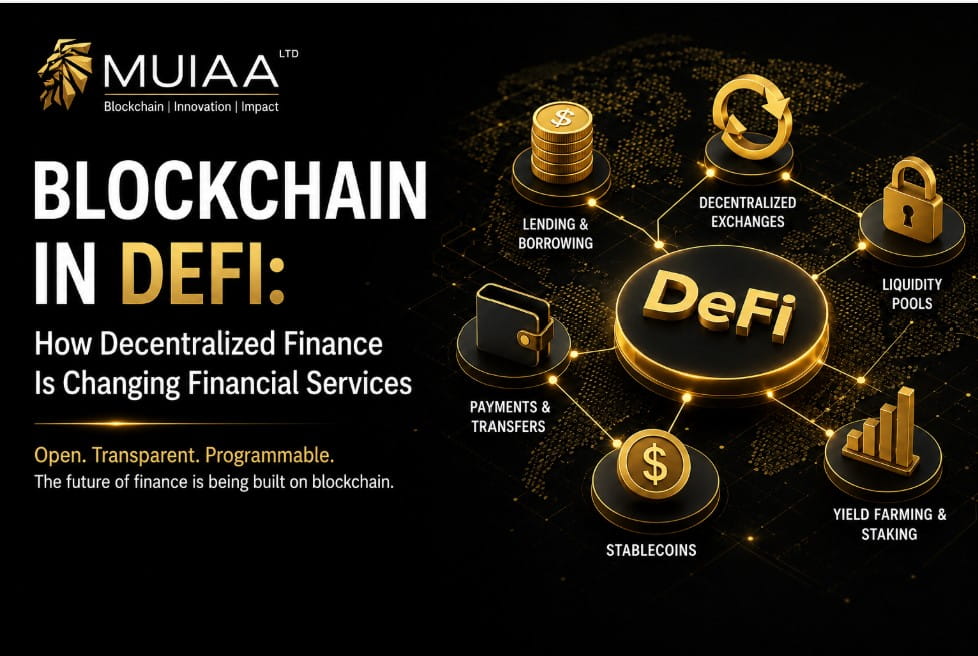
DeFi uses blockchain technology and smart contracts to provide financial services through digital networks without relying on a traditional institution to control every transaction. Users can lend, borrow, trade assets, earn returns, and make payments through blockchain-based applications.
The idea is still relatively new, but the underlying concept is straightforward. Financial rules can be written into software and executed automatically when predefined conditions are met.
This changes the role of the intermediary.
Instead of a bank manually approving every transaction, a smart contract can enforce agreed rules. Instead of a central exchange matching every trade, a decentralized exchange can use blockchain-based liquidity pools. Instead of keeping financial records in one institution’s database, transactions can be recorded on a distributed ledger.
DeFi does not mean traditional finance is disappearing. Banks, regulators, insurers, SACCOs, and other financial institutions still perform functions that blockchain protocols cannot simply replace.
The more useful question is how these two systems can work together.
For Kenya and the wider African market, that question matters. The continent already has a strong fintech sector, widespread mobile money adoption, and a large population that remains underserved by traditional financial services. DeFi could create new ways to access financial products, but it also introduces serious risks involving regulation, cybersecurity, market volatility, and consumer protection.
Understanding both sides is important before deciding where DeFi fits into the future of financial services.
2. What Is Decentralized Finance (DeFi)?
2.1 DeFi Definition
Decentralized finance, or DeFi, refers to blockchain-based financial services that use smart contracts and decentralized applications to provide functions traditionally handled by financial intermediaries.
These services can include:
- Lending and borrowing.
- Payments.
- Asset trading.
- Savings and investment products.
- Insurance.
- Asset management.
- Derivatives.
- Liquidity provision.
Most DeFi applications operate through smart contracts. These are software programs stored on a blockchain that automatically execute instructions when specified conditions are met.
For example, a DeFi lending protocol can allow one user to deposit digital assets into a liquidity pool while another user borrows against eligible collateral. The smart contract manages the rules governing the transaction.
There is no loan officer manually approving the transaction.
The software enforces the conditions.
2.2 How DeFi Differs From Traditional Finance
Traditional finance is built around institutions.
A bank holds deposits and provides loans. An insurance company underwrites risk. A stock exchange provides infrastructure for securities trading. A payment provider processes transactions between customers and merchants.
DeFi moves many of these functions into blockchain-based protocols.
The difference can be summarized simply:
Traditional finance relies heavily on institutions and intermediaries. DeFi relies heavily on blockchain networks, smart contracts, and digital assets.
This does not mean DeFi has no intermediaries at all. Developers, blockchain networks, stablecoin issuers, wallet providers, oracle providers, and other participants can still play important roles.
The structure is simply different.
2.3 How Blockchain Enables DeFi
Blockchain provides the foundation on which DeFi operates.
A blockchain creates a shared digital record of transactions that can be verified by participants in the network. Once transactions are confirmed, the record becomes difficult to alter without detection.
This creates several properties that are useful for financial services:
- Shared transaction records.
- Cryptographic verification.
- Programmable transactions.
- Transparent transaction histories.
- Automated execution.
- Digital ownership of assets.
Smart contracts build on this infrastructure.
They allow developers to create financial applications where rules are written directly into code.
For example, a smart contract can specify that collateral must be deposited before a loan is issued. It can automatically calculate interest, monitor collateral levels, and trigger predefined actions if the borrower fails to meet the protocol’s requirements.
The blockchain provides the infrastructure. Smart contracts provide the financial logic.
2.4 What Makes DeFi Decentralized?
The word “decentralized” refers to how control and decision-making are distributed.
In a traditional financial institution, a central organisation controls the system. It determines who can access a service, maintains records, processes transactions, and enforces internal rules.
A DeFi protocol can distribute these functions across a blockchain network and a set of smart contracts.
Some protocols also use decentralized governance systems where token holders can vote on certain changes to the protocol.
However, decentralization exists on a spectrum.
Some DeFi applications are highly decentralized. Others still depend on centralized companies, development teams, asset issuers, or infrastructure providers.
This distinction matters because calling every blockchain financial application “fully decentralized” can create a misleading picture.
2.5 DeFi vs Traditional Banking
DeFi and traditional banking can provide similar services, but they operate differently.
A bank may assess a customer’s identity, income, credit history, and ability to repay before approving a loan.
A DeFi lending protocol may instead require the borrower to deposit digital assets as collateral before receiving funds.
Traditional banking often depends on:
- Customer accounts.
- Institutional databases.
- Credit assessments.
- Regulatory intermediaries.
- Centralized decision-making.
DeFi often depends on:
- Digital wallets.
- Smart contracts.
- Blockchain networks.
- Digital assets.
- Automated rules.
Each model has strengths and weaknesses.
Traditional finance provides established consumer protections, regulatory oversight, physical and digital service channels, and access to products such as mortgages and business loans.
DeFi can offer open access, programmable financial services, transparent transaction rules, and continuous operation.
The two systems are increasingly beginning to overlap.
Banks and other financial institutions are exploring blockchain-based settlement, tokenized assets, stablecoins, and other technologies that draw from the same infrastructure used by DeFi.
3. How Does DeFi Work?
DeFi can appear complicated because several technologies operate together.
At its core, however, the system has a few important building blocks.
3.1 Blockchain Networks
Every DeFi application needs an underlying blockchain network.
The blockchain records transactions and provides the environment where smart contracts operate.
Different networks offer different combinations of:
- Transaction speed.
- Network fees.
- Security.
- Scalability.
- Programming capabilities.
The choice of blockchain can therefore affect the cost and performance of a DeFi application.
3.2 Smart Contracts
Smart contracts are one of the most important components of DeFi.
A smart contract is a blockchain-based program that automatically executes predefined instructions.
Consider a simple lending arrangement.
A smart contract could specify that:
- A borrower deposits collateral.
- The protocol checks whether the collateral meets the required conditions.
- The borrower receives the permitted loan amount.
- Interest is calculated according to the protocol’s rules.
- The collateral remains locked until the loan is repaid.
- If the collateral value falls below a specified threshold, the protocol can begin liquidation according to its rules.
No employee needs to manually process each step.
The code executes the agreed logic.
This programmability is one of the main reasons blockchain has become useful for financial applications.
3.3 Digital Wallets
Users generally interact with DeFi applications through digital wallets.
A wallet allows users to:
- Hold digital assets.
- Send and receive transactions.
- Connect to DeFi applications.
- Approve transactions.
- Sign messages using cryptographic keys.
This creates a different relationship between users and financial services.
In traditional banking, the institution controls the account infrastructure.
In many DeFi systems, the user controls the wallet and authorizes transactions directly.
That control also creates responsibility. Losing access to a wallet’s private keys can mean losing access to the assets associated with it.
3.4 Decentralized Applications (dApps)
A decentralized application, commonly called a dApp, provides the user interface through which people interact with blockchain protocols.
A DeFi dApp can provide services such as:
- Swapping tokens.
- Depositing assets.
- Borrowing funds.
- Providing liquidity.
- Managing investments.
The interface may look similar to a normal financial application.
The difference is that important transactions are executed through blockchain infrastructure and smart contracts rather than a conventional centralized database alone.
3.5 Tokens and Digital Assets
Tokens represent digital assets that can be transferred and managed on blockchain networks.
They can represent:
- Cryptocurrencies.
- Stablecoins.
- Governance rights.
- Tokenized real-world assets.
- Access rights within an application.
DeFi protocols use these assets as the basic units for financial transactions.
For example, a lending protocol may accept certain tokens as collateral while allowing users to borrow another digital asset.
3.6 Decentralized Exchanges
A decentralized exchange, or DEX, allows users to trade digital assets without relying on a traditional centralized exchange to hold funds and execute every trade.
Many DEXs use automated market makers and liquidity pools.
Instead of matching buyers and sellers through a traditional order book, the protocol can use pools of digital assets supplied by liquidity providers.
Users interact directly with the smart contracts governing the exchange.
This allows trading to operate continuously while reducing dependence on a central exchange operator.
3.7 Oracles
Smart contracts cannot automatically access information from the outside world.
They need a mechanism for receiving external data.
This is where blockchain oracles come in.
Oracles can provide smart contracts with information such as:
- Asset prices.
- Exchange rates.
- Interest rates.
- Weather conditions.
- Market data.
This information can then be used to trigger financial actions.
For example, a DeFi lending protocol may rely on an oracle to determine the market value of collateral.
Oracle security therefore matters greatly. If incorrect or manipulated data reaches a financial smart contract, the protocol can make incorrect decisions.
3.8 Liquidity Pools
Liquidity pools are pools of digital assets locked in smart contracts to support financial activities such as trading and lending.
In a decentralized exchange, for example, users can deposit pairs of assets into a liquidity pool.
Other users can then trade against that pool.
Liquidity providers may receive a portion of the fees generated by transactions.
This creates a new model for supplying financial liquidity without relying entirely on a traditional market-making institution.
However, providing liquidity also carries risks, including market volatility and impermanent loss.
4. Main DeFi Financial Services
DeFi has developed beyond cryptocurrency trading.
Today, blockchain protocols can support a growing range of financial activities.
4.1 DeFi Lending and Borrowing
DeFi lending allows users to lend digital assets through blockchain protocols and earn returns based on the rules of the platform.
Borrowers can access funds by providing collateral.
The process can be automated through smart contracts.
A typical transaction works like this:
- The lender deposits digital assets into a protocol.
- The protocol makes those assets available to eligible borrowers.
- The borrower deposits required collateral.
- The smart contract releases the borrowed assets.
- Interest accrues according to the protocol’s rules.
- The borrower repays the loan.
- Collateral is released when the required conditions are met.
This model removes much of the manual processing associated with traditional lending.
However, most DeFi lending remains heavily dependent on collateral. That makes it different from traditional unsecured lending, where banks may assess income, credit history, employment, and other factors.
4.2 Decentralized Exchanges
Decentralized exchanges allow users to trade digital assets directly through blockchain protocols.
Unlike centralized exchanges, users can often maintain control of their assets until a transaction is executed.
DEXs can offer:
- Continuous trading.
- Direct wallet interaction.
- Global accessibility.
- Transparent transaction records.
- Automated trading mechanisms.
They also introduce risks involving smart contracts, liquidity, price manipulation, and user security.
4.3 Stablecoins
Stablecoins are digital assets designed to maintain a relatively stable value, often by being linked to a fiat currency or supported by reserves or other assets.
They have become an important part of DeFi because they provide a digital unit of account that is less volatile than many cryptocurrencies.
Stablecoins can be used for:
- Payments.
- Lending.
- Borrowing.
- Trading.
- Remittances.
- Liquidity provision.
Their role extends beyond DeFi. Financial institutions and payment companies are also exploring stablecoins for cross-border settlement and other financial applications.
4.4 DeFi Payments
DeFi protocols can support peer-to-peer payments without requiring every transaction to pass through traditional payment intermediaries.
Users can transfer supported digital assets directly through blockchain networks.
The main potential benefits include:
- Continuous availability.
- Programmable transactions.
- Faster settlement.
- Global accessibility.
The practical usefulness of DeFi payments depends heavily on transaction costs, network performance, regulatory requirements, and whether recipients can easily convert digital assets into local currency.
4.5 Yield Farming
Yield farming involves supplying digital assets to DeFi protocols in exchange for potential returns.
Users may provide liquidity to lending protocols, decentralized exchanges, or other applications and receive rewards according to the protocol’s rules.
Returns can come from:
- Trading fees.
- Lending interest.
- Protocol incentives.
- Token rewards.
Yield farming can produce attractive returns, but those returns come with substantial risk.
Token prices can fall. Smart contracts can fail. Liquidity can disappear. Protocol incentives can change.
High advertised yields should therefore never be treated as guaranteed investment returns.
4.6 Staking
Staking involves committing certain digital assets to support the operation or security of a blockchain network.
Depending on the blockchain design, participants may receive rewards for helping validate transactions or secure the network.
Staking is different from lending, although both can generate returns from digital assets.
The risks depend on the blockchain, the staking mechanism, lock-up periods, asset price movements, and the service through which staking is performed.
4.7 Liquidity Provision
Liquidity providers deposit digital assets into DeFi protocols so other users can trade, borrow, or transact.
In exchange, liquidity providers may receive a portion of transaction fees or other protocol rewards.
Liquidity provision is important because decentralized markets need sufficient liquidity to function efficiently.
Without enough liquidity, users may face significant price differences between the amount they expect to pay and the amount they actually receive.
4.8 Decentralized Insurance
Blockchain can also support alternative approaches to insurance.
Some decentralized insurance protocols allow users to contribute funds to shared pools that can compensate participants when predefined events occur.
Smart contracts can automate certain claims processes when reliable data confirms that the conditions of a policy have been met.
This could reduce administrative costs and improve transparency.
However, decentralized insurance remains an emerging area and faces challenges involving risk assessment, claims verification, capital adequacy, and regulation.
4.9 Asset Tokenization
Tokenization involves representing ownership or rights to an asset through blockchain-based tokens.
Assets that may be tokenized include:
- Government securities.
- Corporate debt.
- Real estate interests.
- Commodities.
- Investment funds.
Tokenization can make traditionally difficult-to-transfer assets more programmable and easier to integrate into digital financial systems.
It also creates opportunities for DeFi protocols to interact with assets linked to the traditional economy.
4.10 Decentralized Asset Management
Traditional asset management depends on professional managers and financial institutions making investment decisions on behalf of clients.
DeFi introduces automated approaches where smart contracts can execute investment strategies according to predefined rules.
Some protocols allow users to deposit assets into automated strategies that rebalance portfolios, provide liquidity, or interact with other DeFi applications.
This creates new possibilities for financial automation, but it also means users must understand the risks embedded in the underlying code and strategy.
5. DeFi vs Traditional Finance
DeFi and traditional finance are built around different operating models, but they increasingly overlap.
Traditional financial institutions provide services through regulated organisations with established governance structures. DeFi protocols use blockchain networks and smart contracts to automate many financial functions.
5.1 Control
Traditional finance generally places control with a central institution.
A bank controls customer accounts and manages its internal transaction records.
DeFi can distribute control across blockchain networks, smart contracts, developers, and governance participants.
This can reduce dependence on a single institution, but it also means users may have greater responsibility for managing their own assets and security.
5.2 Access
Traditional financial services often require customers to meet eligibility requirements.
These may include:
- Identity verification.
- Proof of income.
- Credit assessments.
- Geographic requirements.
- Minimum balances.
Some DeFi protocols can be accessed by anyone with a compatible digital wallet and sufficient network access.
That openness is one of DeFi’s strongest arguments for financial inclusion.
It is also one of its biggest regulatory challenges.
5.3 Operating Hours
Banks and financial markets often operate according to defined schedules, although digital banking has extended access considerably.
Blockchain networks can operate continuously.
DeFi applications can therefore process transactions 24 hours a day, including weekends and public holidays.
This is particularly useful for global users operating across different time zones.
5.4 Transparency
Traditional financial institutions maintain private internal records and disclose information according to regulatory requirements.
Many DeFi transactions can be viewed on public blockchains.
Users and researchers can inspect transaction activity, smart contract interactions, and liquidity levels depending on the network and protocol.
This creates a high level of transaction transparency.
However, transparency of blockchain transactions does not automatically mean that users are fully identifiable. Wallet addresses may not directly reveal the real-world identity of their owners.
5.5 Automation
Traditional financial services rely heavily on employees, internal systems, and institutional processes.
DeFi can automate financial rules through smart contracts.
For example, a smart contract can automatically release collateral after a loan has been repaid.
This reduces manual intervention and creates predictable execution based on programmed rules.
5.6 Consumer Protection
Traditional financial institutions operate within regulatory frameworks designed to protect consumers.
Customers may have access to complaint procedures, deposit protection schemes, financial ombudsman services, and other safeguards depending on the country and type of financial service.
DeFi users may have significantly fewer protections.
If a smart contract is exploited or a user loses access to their private keys, recovering funds may be difficult or impossible.
This is one of the clearest areas where traditional finance currently has an advantage.
6. Benefits of DeFi
DeFi has attracted attention because blockchain can remove some of the structural barriers found in traditional financial systems.
The benefits are significant, but they should always be considered alongside the risks.
6.1 Financial Accessibility
One of DeFi’s defining features is open access.
A person with an internet connection, compatible wallet, and supported digital assets can potentially interact with financial protocols without opening an account at a traditional financial institution.
This creates opportunities for people who may have limited access to conventional banking.
However, access still depends on digital connectivity, financial literacy, technology, and the ability to acquire and securely manage digital assets.
6.2 24/7 Financial Services
Blockchain networks operate continuously.
Users don’t necessarily have to wait for banking hours or traditional settlement windows to interact with a DeFi protocol.
This is particularly useful for global transactions where users operate across multiple time zones.
6.3 Faster Transactions
Blockchain can settle transactions faster than some traditional financial processes, particularly where multiple intermediaries would otherwise be involved.
The actual speed depends on the blockchain network and the type of transaction.
A fast blockchain does not automatically mean an instant financial service. Identity checks, compliance requirements, and conversion into local currency can still introduce delays.
6.4 Potentially Lower Costs
Removing or reducing intermediary processes can lower certain transaction costs.
DeFi can reduce expenses associated with:
- Manual processing.
- Reconciliation.
- Settlement.
- Some forms of financial intermediation.
However, blockchain network fees can also become expensive during periods of high demand.
Lower costs should therefore be viewed as a potential benefit rather than a guarantee.
6.5 Greater Transparency
Public blockchain networks provide transaction records that can often be independently inspected.
This allows users and researchers to analyse:
- Transaction activity.
- Liquidity.
- Token movements.
- Protocol interactions.
Such transparency is difficult to achieve with traditional financial databases that are largely controlled by individual institutions.
6.6 Programmable Financial Services
Programmability is one of DeFi’s most important advantages.
Financial rules can be written directly into smart contracts.
This allows developers to create services that automatically:
- Calculate interest.
- Move funds.
- Manage collateral.
- Execute trades.
- Distribute rewards.
- Trigger payments.
The result is a financial system where software can perform tasks that traditionally required several intermediaries.
6.7 Global Accessibility
Many DeFi protocols are accessible across borders.
A user in Kenya can potentially interact with a protocol developed in another country without establishing a traditional banking relationship with the institution behind it.
This creates a global financial environment that is fundamentally different from geographically fragmented banking systems.
Regulation still applies, however. Global technical accessibility does not mean that every DeFi service is legally available in every jurisdiction.
6.8 Reduced Dependence on Intermediaries
Traditional finance often depends on several intermediaries.
DeFi can reduce this dependence by allowing users and smart contracts to interact directly.
Fewer intermediaries can mean:
- Faster processing.
- Lower administrative costs.
- Greater transparency.
- More programmable transactions.
The trade-off is that users take on more responsibility for managing wallets, keys, transactions, and financial risk.
7. Risks and Challenges of DeFi
DeFi can make financial services more accessible and programmable, but removing traditional intermediaries also removes some of the protections they provide.
Users therefore need to understand where the risks sit before interacting with DeFi protocols.
7.1 Smart Contract Vulnerabilities
Smart contracts control many DeFi transactions.
If the underlying code contains a vulnerability, attackers may exploit it to steal funds or manipulate the protocol.
This creates a unique risk because blockchain transactions are often irreversible.
A traditional financial institution can sometimes freeze an account, reverse a transaction, or investigate suspicious activity. A compromised smart contract may not provide the same options.
Independent code audits can reduce risk, but an audit doesn’t guarantee that a protocol is completely secure.
7.2 Cryptocurrency Volatility
Many DeFi applications depend on cryptocurrencies and other digital assets whose prices can change rapidly.
A borrower may deposit an asset as collateral and see its market value fall sharply.
If the collateral drops below the required threshold, the protocol may automatically liquidate the position.
Similarly, an investor earning a high yield may still lose money if the value of the underlying token falls significantly.
The return generated by a DeFi protocol should therefore always be considered alongside the market risk of the assets involved.
7.3 DeFi Scams and Fraud
The rapid growth of DeFi has attracted legitimate developers and financial innovators, but it has also attracted fraudsters.
Common scams include:
- Fake DeFi platforms.
- Fraudulent tokens.
- Ponzi schemes.
- Phishing websites.
- Fake investment opportunities.
- Malicious smart contracts.
- Impersonation of legitimate projects.
Some fraudulent projects are designed to look like established financial applications.
Users should verify the official application, understand how funds are being used, and be cautious about promises of guaranteed or unusually high returns.
7.4 Loss of Private Keys
Self-custody gives users greater control over their assets.
It also creates greater responsibility.
A private key or recovery phrase can provide access to a digital wallet. If it is lost or stolen, recovering the associated assets may be extremely difficult.
This is different from traditional banking, where customers can often recover access to an account through identity verification and institutional support.
DeFi therefore requires a higher level of personal responsibility for digital security.
7.5 Regulatory Uncertainty
Financial services are heavily regulated because they affect consumers, businesses, markets, and the wider economy.
DeFi creates difficult regulatory questions.
Authorities must consider:
- Who is responsible for a decentralized protocol?
- How should DeFi lending be regulated?
- How should customer protection work?
- How should taxation apply?
- How should AML requirements be implemented?
- How should cross-border DeFi transactions be monitored?
Regulation is developing at different speeds across countries.
This uncertainty can affect both users and businesses building DeFi applications.
7.6 Liquidity Risks
DeFi markets depend heavily on liquidity.
A protocol may appear healthy during normal market conditions but struggle when many users attempt to withdraw assets at the same time.
Low liquidity can lead to:
- Larger price movements.
- Higher trading costs.
- Difficulty exiting positions.
- Greater losses during market stress.
Liquidity providers can also experience losses when the prices of assets in a liquidity pool move significantly relative to one another.
7.7 Oracle Manipulation
DeFi protocols often depend on external data to determine asset prices and trigger financial decisions.
If an oracle provides inaccurate or manipulated information, a smart contract may make an incorrect decision.
For example, an inaccurate asset price could cause a lending protocol to:
- Accept insufficient collateral.
- Liquidate a healthy position.
- Miscalculate borrowing limits.
Reliable oracle infrastructure is therefore an important part of secure DeFi systems.
7.8 Market Manipulation
Some DeFi markets have lower liquidity than established financial markets.
This can make certain assets more vulnerable to price manipulation.
Bad actors may attempt to influence prices, exploit temporary market differences, or take advantage of weaknesses in automated trading mechanisms.
As DeFi markets mature, stronger monitoring, deeper liquidity, and better risk controls will become increasingly important.
7.9 Lack of Consumer Protection
Traditional financial systems have developed mechanisms for protecting consumers.
Depending on the jurisdiction and product, these can include:
- Deposit insurance.
- Dispute resolution.
- Fraud investigations.
- Regulatory supervision.
- Customer compensation mechanisms.
DeFi users may not have equivalent protections.
If funds are lost because of a software vulnerability, phishing attack, or user error, there may be no institution responsible for reimbursing the customer.
This is one of the biggest differences between DeFi and regulated financial services.
7.10 Technical Complexity
DeFi requires users to understand concepts that don’t normally arise in everyday banking.
These include:
- Wallet addresses.
- Private keys.
- Gas fees.
- Smart contracts.
- Liquidity pools.
- Token approvals.
- Network selection.
A simple mistake can result in funds being sent to the wrong address or a user interacting with a malicious application.
Improving the user experience and financial education will therefore be important if DeFi is to reach a broader audience.
7.11 Scalability and Network Fees
Blockchain networks have limits on how many transactions they can process efficiently.
When demand increases, transaction fees can rise.
For DeFi users, high network fees can reduce the attractiveness of smaller transactions and make some financial activities impractical.
Developers are addressing these problems through improvements to blockchain infrastructure, layer-2 networks, and other scaling solutions.
8. DeFi and Financial Inclusion
Financial inclusion means giving individuals and businesses access to useful, affordable, and appropriate financial services.
DeFi has the potential to contribute to this goal because many protocols are designed around open digital access.
But technology alone doesn’t create financial inclusion.
People also need reliable internet access, digital literacy, secure devices, appropriate regulation, and practical ways to convert digital assets into money they can use in everyday life.
8.1 Access for Underserved Populations
Traditional financial institutions may be difficult to access for people living far from bank branches or those who don’t meet conventional account requirements.
DeFi can reduce some of these barriers by allowing users to interact with financial protocols through digital wallets.
This can be particularly relevant in regions where mobile technology has expanded faster than traditional banking infrastructure.
However, open access doesn’t automatically mean responsible access. Users still need protection from fraud, excessive risk, and unsuitable financial products.
8.2 Alternative Lending Models
Traditional lending often depends on credit histories, income verification, and institutional assessments.
DeFi lending commonly uses digital assets as collateral.
This creates an alternative model where access to liquidity depends more directly on the assets a user can pledge than on a traditional credit score.
Over time, blockchain-based identity and reputation systems could potentially allow more sophisticated forms of decentralized credit assessment.
That could make DeFi lending more useful for individuals and businesses that have limited traditional credit histories.
8.3 Cross-Border Financial Services
International financial services can be expensive and difficult to access.
DeFi can allow digital assets to move across blockchain networks without following the same infrastructure used by traditional correspondent banking systems.
This creates potential opportunities for:
- International payments.
- Remittances.
- Cross-border business transactions.
- Digital savings.
- Global investment.
Stablecoins are particularly relevant because they can provide a blockchain-based representation of relatively stable value.
8.4 Lower Barriers to Financial Participation
Traditional investment products can involve account opening requirements, geographic restrictions, minimum balances, and intermediary fees.
DeFi protocols can lower some of these barriers.
Users may be able to participate in lending, liquidity provision, trading, or other financial activities using relatively small amounts of digital assets.
However, lower entry barriers can also expose inexperienced users to financial risks they may not fully understand.
Accessibility should therefore go hand in hand with education.
8.5 DeFi and the Unbanked
DeFi is sometimes presented as a solution for the world’s unbanked population.
The idea has merit, but there are practical limitations.
A person without a bank account may still need:
- A smartphone or computer.
- Internet access.
- A digital wallet.
- Digital assets.
- Knowledge of blockchain transactions.
- A reliable method of converting assets into local currency.
This means DeFi may complement financial inclusion efforts rather than independently solve the problem.
8.6 DeFi and Small Businesses
Small businesses often struggle with access to affordable credit, cross-border payments, and investment opportunities.
DeFi could create alternative channels for:
- Business financing.
- International payments.
- Treasury management.
- Digital asset settlement.
- Access to global liquidity.
For African businesses engaged in international trade, faster settlement and reduced payment friction could be particularly valuable.
The challenge is creating systems that combine these benefits with appropriate regulatory oversight and consumer protection.
9. DeFi in Africa
Africa has become one of the world’s most interesting markets for financial technology.
Mobile money has already demonstrated that financial services can leapfrog traditional infrastructure. DeFi represents another potential layer in this evolution.
Its adoption, however, will depend on whether it can solve practical problems rather than simply introduce new technology.
9.1 Africa’s Fintech Ecosystem
African fintech companies have developed solutions for payments, lending, savings, insurance, remittances, and business finance.
Many of these businesses operate in markets where traditional financial infrastructure has historically been limited.
This creates an environment where blockchain-based financial services could complement existing digital finance.
Rather than forcing consumers to abandon mobile money and banking, future systems could connect blockchain infrastructure with the payment channels people already use.
9.2 Mobile Money and DeFi
Mobile money has become a critical part of financial life in several African countries.
DeFi could potentially connect blockchain-based financial products with mobile financial ecosystems.
For example, blockchain could provide the underlying settlement infrastructure while mobile applications provide the user-facing experience.
This could make blockchain-based services easier for ordinary consumers to use.
The technical integration remains complex, particularly around regulation, identity, interoperability, and conversion between digital assets and local currencies.
9.3 Cross-Border Payments
African businesses frequently operate across national borders.
Moving money between countries can involve different currencies, banking systems, regulations, and settlement processes.
Blockchain-based payment networks could reduce some of these barriers.
Potential applications include:
- Regional trade payments.
- Supplier settlements.
- Freelancer payments.
- Remittances.
- International business transactions.
This connects directly with the opportunities discussed in our article on Blockchain Payments and Remittances.
9.4 DeFi Lending Opportunities
Small businesses across Africa often face difficulties obtaining affordable formal credit.
DeFi introduces alternative lending mechanisms based primarily on digital collateral.
This model has limitations because businesses that don’t already hold digital assets may struggle to access overcollateralized DeFi loans.
Future developments in blockchain-based identity, tokenized real-world assets, and decentralized credit assessment could potentially expand the range of borrowers who can participate.
9.5 Challenges Facing DeFi Adoption in Africa
Several barriers could slow adoption.
These include:
- Internet access.
- Digital literacy.
- Cryptocurrency volatility.
- Regulatory uncertainty.
- Limited consumer protection.
- Cybersecurity risks.
- Local currency conversion.
- Lack of trusted infrastructure.
There is also the question of whether DeFi products solve problems that African consumers actually face.
A technology that is technically impressive but difficult to use or poorly connected to local payment systems is unlikely to achieve mass adoption.
9.6 The Role of Regulation
African regulators have an important role in shaping the future of DeFi.
A balanced regulatory approach can allow innovation while protecting consumers and maintaining financial stability.
Regulators may need to consider issues involving:
- Digital asset licensing.
- KYC and AML compliance.
- Taxation.
- Consumer protection.
- Data privacy.
- Cross-border transactions.
- Financial stability.
Clear rules can also give legitimate businesses greater confidence to invest in blockchain-based financial products.
:::
10. DeFi in Kenya
Kenya has already shown how quickly financial technology can change everyday financial behaviour.
Mobile money transformed payments, savings, and business transactions without requiring the country to build a traditional banking relationship for every user. This history makes Kenya an important market for understanding how blockchain and DeFi could develop in Africa.
DeFi is still an emerging area in Kenya, and its long-term role will depend on regulation, infrastructure, consumer awareness, and whether the technology can address genuine financial needs.
10.1 Kenya’s Digital Financial Ecosystem
Kenya has one of Africa’s most developed digital finance ecosystems.
Consumers and businesses regularly use digital platforms for:
- Sending and receiving money.
- Paying bills.
- Buying goods and services.
- Receiving salaries.
- Saving.
- Accessing credit.
- Managing business payments.
This provides a strong foundation for experimenting with new financial technologies.
Blockchain and DeFi could build on this digital behaviour by introducing programmable financial services that operate across blockchain networks.
The challenge is making those services simple enough for ordinary users while maintaining the safeguards expected from regulated financial institutions.
10.2 Mobile Money and DeFi
Mobile money and DeFi serve different purposes, but they can potentially complement each other.
Mobile money provides a familiar way for people to interact with digital money using mobile phones. DeFi provides blockchain-based infrastructure for financial activities such as lending, trading, and asset management.
Future financial products could potentially connect these systems.
For example, a user-facing application could hide much of the technical complexity of blockchain while allowing users to access blockchain-based financial services through an interface similar to the digital financial applications they already understand.
The success of such models would depend on interoperability, regulation, security, and reliable conversion between digital assets and Kenyan shillings.
10.3 DeFi and Financial Inclusion in Kenya
Kenya has made significant progress in expanding access to financial services, but some individuals and businesses still face barriers to affordable credit, investment products, and international financial services.
DeFi could provide additional channels for accessing financial products.
Potential applications include:
- Digital lending.
- Cross-border payments.
- Savings products.
- Investment platforms.
- Tokenized assets.
- Business financing.
However, DeFi should complement existing financial inclusion efforts rather than be presented as a replacement for banks, SACCOs, or mobile money.
The strongest applications will likely be those that solve specific problems while fitting into the financial systems people already use.
10.4 DeFi Lending Opportunities
Access to affordable credit remains an important issue for individuals and businesses.
Traditional lenders generally rely on information such as income, credit history, collateral, and repayment capacity when assessing borrowers.
DeFi lending works differently.
Many protocols require borrowers to provide digital assets as collateral before accessing loans.
This limits the usefulness of conventional DeFi lending for people who don’t already own digital assets.
The next stage of development could be more interesting.
Blockchain-based identity, tokenized real-world assets, and alternative credit assessment systems could potentially allow DeFi protocols to serve a broader range of borrowers.
That could create opportunities for businesses that have limited access to conventional financing, provided appropriate consumer and investor protections are in place.
10.5 DeFi and Cross-Border Payments
Kenyan businesses increasingly participate in regional and international commerce.
Freelancers work with international clients. Importers purchase goods from overseas suppliers. Exporters receive payments from foreign customers. Families receive money from relatives working abroad.
DeFi and blockchain payment networks can potentially reduce some of the friction associated with these transactions.
Stablecoins are particularly relevant because they can provide a blockchain-based digital representation of relatively stable value.
A business could potentially receive a digital payment, settle the transaction on a blockchain network, and convert the funds into local currency through a compliant financial service.
The technology can shorten settlement paths, but local regulation, foreign exchange requirements, taxation, and compliance still need to be addressed.
10.6 Opportunities for Kenyan Businesses
Businesses could potentially use DeFi infrastructure for more than borrowing.
Possible applications include:
- International supplier payments.
- Digital treasury management.
- Automated settlements.
- Tokenized assets.
- Cross-border collections.
- Access to global liquidity.
- Programmable business payments.
Smart contracts could also automate certain business agreements.
For example, a payment could be released automatically when predefined conditions are verified.
This could reduce administrative work in areas such as trade, logistics, and supply chain finance.
10.7 Regulatory Considerations in Kenya
DeFi operates at the intersection of technology and financial services.
That creates important regulatory questions.
Businesses involved in DeFi may need to consider requirements relating to:
- Digital assets.
- Consumer protection.
- Anti-money laundering.
- Know Your Customer procedures.
- Taxation.
- Data protection.
- Payments.
- Securities.
- Cross-border transactions.
The regulatory treatment can also depend on the specific financial product being offered.
A DeFi lending platform, tokenized investment product, payment service, and decentralized exchange may raise very different regulatory issues.
For Kenyan businesses, understanding the applicable rules before launching a blockchain financial product will be as important as building the technology itself.
11. DeFi and Financial Institutions
DeFi doesn’t exist in isolation from the financial sector.
Banks, SACCOs, insurance companies, fintechs, investment firms, and other financial institutions are increasingly examining blockchain because it can improve the infrastructure supporting financial services.
The future may therefore involve more interaction between decentralized protocols and regulated institutions.
11.1 Banks and DeFi
Banks are exploring blockchain for areas such as:
- Payments.
- Settlement.
- Tokenized deposits.
- Digital assets.
- Trade finance.
- Asset tokenization.
Rather than replacing banks, blockchain could change how some banking services are delivered.
Banks could also provide the regulated interface between blockchain-based financial products and customers who prefer conventional financial services.
This creates a possible model where decentralized technology operates behind the scenes while customers continue interacting with familiar banking applications.
11.2 SACCOs and DeFi
SACCOs play an important role in Kenya’s financial system, particularly for members who rely on collective savings and lending.
Blockchain could improve areas such as:
- Member records.
- Transaction transparency.
- Loan administration.
- Digital identity.
- Cross-border payments.
DeFi could eventually introduce additional financial infrastructure for savings, lending, and investment.
However, SACCOs operate under specific regulatory and governance frameworks. Any blockchain or DeFi application would need to work within those requirements.
This makes the earlier discussion on blockchain for SACCOs particularly relevant to the wider DeFi conversation.
11.3 Insurance and DeFi
Insurance is another area where blockchain and decentralized finance can overlap.
Smart contracts can automate certain insurance processes when reliable external information confirms that predefined conditions have occurred.
For example, a smart contract could potentially trigger a payout when an agreed event is independently verified.
This can reduce administrative delays and improve transparency.
However, insurance involves complex risk assessment and regulatory requirements. Fully decentralized insurance remains an emerging field rather than a replacement for established insurance companies.
11.4 Fintech Companies and DeFi
Fintech companies may be among the best positioned to connect DeFi infrastructure with mainstream users.
They already understand:
- Digital payments.
- Customer experience.
- Financial regulation.
- Mobile applications.
- Data security.
- Financial inclusion.
A fintech company could potentially use blockchain infrastructure without requiring customers to understand every technical detail.
This could make DeFi-based services easier to use while retaining familiar digital interfaces.
11.5 Investment Firms and DeFi
Investment firms are also exploring blockchain-based assets and tokenization.
DeFi can provide infrastructure for:
- Digital asset trading.
- Liquidity management.
- Tokenized investment products.
- Automated portfolio strategies.
- Digital asset settlement.
Institutional participation could bring greater liquidity, stronger governance, and more mature risk management to the DeFi ecosystem.
At the same time, increased institutional involvement may lead to more regulation and greater integration with traditional financial markets.
11.6 The Convergence of DeFi and Traditional Finance
The long-term financial system may not be divided into traditional finance on one side and DeFi on the other.
A hybrid model is more likely.
Banks could provide regulated financial services while using blockchain for settlement. Fintechs could build user-friendly applications on blockchain infrastructure. Investment firms could issue tokenized assets. Payment companies could use stablecoins for international settlement.
In this model, blockchain becomes part of the financial infrastructure rather than a separate financial universe.
That convergence could make blockchain less visible to the average customer while making its underlying infrastructure more important.
12. The Future of DeFi
DeFi is still developing.
Some early ideas will fail. Others will evolve into financial products that become part of the mainstream financial system.
The direction of travel will depend on technology, regulation, consumer demand, and the ability of developers and financial institutions to solve real problems.
12.1 DeFi and Traditional Finance Convergence
The separation between DeFi and traditional finance is already becoming less clear.
Financial institutions are exploring blockchain-based settlement, tokenized assets, stablecoins, and digital currencies.
At the same time, DeFi developers are building systems that increasingly interact with traditional financial assets.
The future may therefore involve financial services that combine institutional oversight with blockchain-based infrastructure.
12.2 Institutional DeFi
Institutional DeFi refers to blockchain-based financial services designed to meet the requirements of banks, investment firms, corporations, and other regulated organisations.
Institutional users generally require:
- Strong compliance controls.
- Reliable identity systems.
- Transaction monitoring.
- Privacy.
- Regulatory clarity.
- Institutional-grade security.
Meeting these requirements could help move DeFi beyond its current crypto-focused user base.
12.3 Tokenized Real-World Assets
Tokenization could become one of the most important bridges between DeFi and the traditional economy.
Real-world assets such as government securities, bonds, real estate interests, and investment funds can potentially be represented through blockchain-based tokens.
Once tokenized, these assets can interact with blockchain-based financial applications.
This could create new forms of:
- Trading.
- Lending.
- Collateralization.
- Settlement.
- Investment.
The technology also creates important legal questions because ownership of a blockchain token must be properly connected to legal ownership of the underlying asset.
12.4 Stablecoins
Stablecoins are likely to remain an important part of DeFi.
Their relative price stability makes them useful for:
- Trading.
- Lending.
- Payments.
- Remittances.
- Savings.
- Cross-border settlement.
Their future growth will depend heavily on regulation, reserve transparency, market confidence, and integration with traditional financial systems.
12.5 Central Bank Digital Currencies
Central Bank Digital Currencies, or CBDCs, could introduce another connection between blockchain technology and traditional monetary systems.
CBDCs are digital forms of sovereign currency issued by central banks.
They differ from privately issued stablecoins because they represent direct claims on a central bank, depending on the design of the system.
CBDCs could potentially interact with blockchain-based financial infrastructure and support:
- Digital payments.
- Programmable transactions.
- Government disbursements.
- Cross-border settlement.
- Financial inclusion.
The extent to which CBDCs interact directly with DeFi will depend on how individual countries design and regulate them.
12.6 AI and DeFi
Artificial intelligence could add another layer of automation to decentralized financial systems.
AI systems can analyse large amounts of data and identify patterns that may be difficult to detect manually.
Potential applications include:
- Fraud detection.
- Risk assessment.
- Market analysis.
- Portfolio management.
- Transaction monitoring.
- Customer support.
Blockchain provides a trusted transaction record while AI can analyse that data and support decision-making.
The combination could create more automated financial services, although both technologies introduce their own risks.
12.7 Regulation and Mainstream Adoption
Regulation will have a major influence on DeFi’s future.
Clear rules can give legitimate businesses confidence to invest in the sector while providing consumers with stronger protections.
The challenge will be developing rules that address genuine financial risks without preventing useful innovation.
As DeFi becomes more connected to banks, payment providers, investment firms, and other regulated institutions, compliance will become increasingly important.
12.8 DeFi as Programmable Finance
The most important long-term contribution of DeFi may not be cryptocurrency itself.
It may be the idea that financial services can become programmable.
Instead of a financial product being a fixed service delivered by an institution, developers can create financial rules that automatically interact with other applications.
A payment can trigger another payment.
Collateral can automatically adjust borrowing limits.
An investment portfolio can rebalance according to predefined rules.
A trade can settle automatically when conditions are met.
This programmability could change how financial products are designed and delivered.
13. Frequently Asked Questions
13.1 What is DeFi?
DeFi, or decentralized finance, refers to blockchain-based financial services that use smart contracts and decentralized applications to provide functions traditionally handled by financial intermediaries.
13.2 How does DeFi work?
DeFi uses blockchain networks, smart contracts, digital wallets, tokens, and decentralized applications to provide financial services such as lending, borrowing, trading, payments, and asset management.
13.3 Is DeFi built on blockchain?
Yes.
Blockchain provides the infrastructure that records transactions and allows smart contracts to execute financial rules.
13.4 What is the difference between DeFi and traditional finance?
Traditional finance relies primarily on regulated financial institutions and intermediaries. DeFi uses blockchain networks and smart contracts to automate many financial activities and reduce dependence on centralized intermediaries.
13.5 What are smart contracts in DeFi?
Smart contracts are blockchain-based programs that automatically execute predefined instructions when specified conditions are met.
13.6 What is DeFi lending?
DeFi lending allows users to deposit digital assets into blockchain-based lending protocols and earn returns while borrowers access funds, usually by providing collateral.
13.7 How do DeFi exchanges work?
Decentralized exchanges allow users to trade digital assets through blockchain-based smart contracts rather than relying entirely on a centralized exchange to hold and process transactions.
13.8 What are liquidity pools?
Liquidity pools are collections of digital assets locked in smart contracts. They provide liquidity for activities such as decentralized trading and lending.
13.9 What is yield farming?
Yield farming involves supplying digital assets to DeFi protocols in exchange for potential returns from activities such as trading fees, lending interest, or protocol rewards.
13.10 What are the risks of DeFi?
Major risks include smart contract vulnerabilities, cryptocurrency volatility, fraud, private key loss, liquidity problems, oracle manipulation, regulatory uncertainty, and limited consumer protection.
13.11 Is DeFi safe?
DeFi can be secure when built and used properly, but it carries risks that differ from traditional financial services. Users should understand the protocol, smart contract, digital assets, and security requirements before committing funds.
13.12 Can DeFi replace banks?
DeFi is unlikely to replace all banking functions. Banks provide regulated services, customer support, credit assessment, deposit management, and other functions that decentralized protocols don’t automatically provide.
A more likely outcome is greater interaction between DeFi infrastructure and traditional financial institutions.
13.13 How does DeFi support financial inclusion?
DeFi can reduce some barriers to accessing financial services by allowing users to interact with blockchain-based financial applications without opening a traditional bank account. However, meaningful inclusion also requires internet access, digital literacy, security, regulation, and practical ways to use digital assets.
13.14 Can DeFi work in Kenya?
DeFi has potential applications in Kenya, particularly in payments, lending, cross-border transactions, and digital financial services. Its wider adoption will depend on infrastructure, regulation, consumer protection, and whether products address genuine local financial needs.
13.15 How is DeFi regulated?
DeFi regulation varies by jurisdiction and depends on the type of financial service involved. Regulators may consider requirements relating to digital assets, securities, payments, AML, KYC, taxation, consumer protection, and financial stability.
13.16 What are stablecoins in DeFi?
Stablecoins are digital assets designed to maintain a relatively stable value, often through a link to a fiat currency or other assets. They are widely used in DeFi for trading, lending, borrowing, payments, and liquidity.
13.17 What is the future of DeFi?
The future of DeFi is likely to involve greater integration with traditional finance, tokenized real-world assets, stablecoins, institutional participation, improved regulation, and more programmable financial services.
13.18 How can businesses benefit from DeFi?
Businesses may use DeFi infrastructure for international payments, digital asset settlement, liquidity management, tokenized assets, financing, and automated transactions. The suitability depends on the business model, regulatory environment, and risk involved.
Conclusion
DeFi is changing the way people think about financial infrastructure. Instead of every financial service depending on a central institution, blockchain allows some financial functions to be delivered through software, smart contracts, and decentralized networks.
The technology offers real opportunities. Lending can become more programmable. Payments can operate around the clock. Digital assets can move across borders. Financial products can interact with one another through smart contracts.
But DeFi also creates new responsibilities.
Users can lose money through volatile assets, insecure wallets, flawed smart contracts, fraud, or inadequate risk management. Businesses face regulatory and compliance challenges. Governments must balance innovation with consumer protection and financial stability.
For Kenya, the opportunity is especially interesting because the country already has a strong digital finance culture. The next stage could involve connecting blockchain infrastructure with the mobile money, banking, fintech, SACCO, and payment systems that people already use.
DeFi should therefore be viewed with both ambition and caution.
Its biggest contribution may ultimately be the idea of programmable finance, where financial services can interact automatically, operate continuously, and connect across different systems. That could create a financial ecosystem where blockchain technology works alongside banks and fintech companies rather than simply trying to replace them.
How MUIAA Is Contributing to Blockchain Innovation
At MUIAA, we’re interested in blockchain because of the practical financial problems it can help solve. Our work goes beyond explaining emerging technologies. We’re exploring how blockchain can be applied to real financial services, from payments and digital identity to lending, SACCO management, insurance, and decentralized finance.
Through our research, educational content, and technology initiatives, MUIAA is working toward a future where blockchain isn’t treated as a complicated technology reserved for specialists. We want to understand where it creates genuine value and develop solutions that can make financial services more accessible, transparent, secure, and efficient.
As DeFi continues to evolve, MUIAA sees an opportunity to connect blockchain innovation with the realities of businesses and consumers in Kenya and across Africa. The goal is practical innovation: building and supporting financial products that use emerging technology to address real needs while respecting the importance of trust, regulation, and consumer protection.
For this kind of news, articles, tutorials and more, visit us at MUIAA Ltd where we offer research, advice and build modern day innovations in blockchain, fintech, and digital finance across emerging markets. We help turn ground-level realities into practical financial tools.