

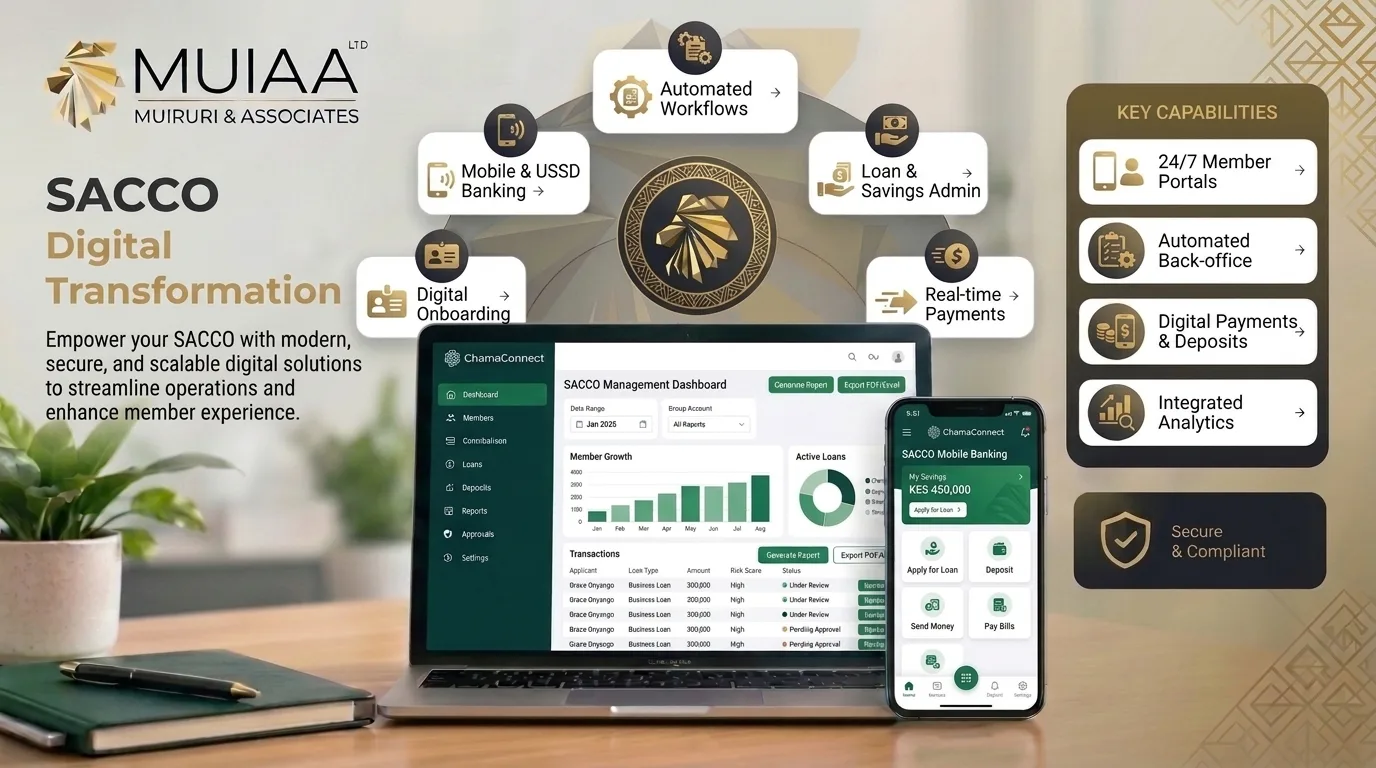



A SACCO can have reliable financial policies, experienced staff and a growing membership, yet still struggle with disconnected systems, slow reporting and manual processes. As transactions increase, these problems become harder to manage.
Digital transformation gives SACCOs a way to improve how they operate. It involves reviewing existing processes, adopting suitable technologies, connecting information systems and preparing staff and members to work in a more digital environment.
For Kenyan SACCOs, this transition also involves data protection, cybersecurity, governance and regulatory considerations. Choosing software is only one part of the process. The organisation must understand what it wants to improve, how its systems will work together and how the changes will affect its members.
Key Takeaways
- SACCO digital transformation is the process of improving cooperative operations through technology, connected systems, better data management and redesigned workflows.
- Digitisation involves converting information into digital formats, while digitalisation uses technology to improve existing processes. Digital transformation involves broader organisational change.
- Kenyan SACCOs should assess their operational needs, regulatory obligations, data protection responsibilities and technology readiness before adopting new systems.
- A successful transition should cover member services, savings, contributions, loans, financial reporting, governance and internal controls.
- System integration matters. Adding several disconnected applications can create more administrative work instead of reducing it.
- Data migration requires careful preparation, verification and reconciliation. Incorrect historical information can undermine a new digital system.
- Staff training, member adoption and change management are as important as the technology itself.
- Blockchain can support selected processes through tamper-evident records and transaction traceability, but it doesn’t replace sound governance, accurate data or proper financial controls.
1. What Is SACCO Digital Transformation?
SACCO digital transformation is the process of using digital technologies to improve how a savings and credit cooperative manages its members, financial activities, internal operations and services.
It can involve replacing paper-based procedures, connecting separate systems, automating repetitive tasks, improving access to financial information and introducing digital channels for members.
For example, a SACCO that previously recorded member contributions in spreadsheets may introduce a digital system that connects payment information to individual member accounts. Authorised staff can review transactions, monitor balances and generate reports from the same environment.
The change affects how the organisation works, not simply where it stores information.
A complete transformation may involve:
- Digital member registration and account management.
- Electronic contribution and savings tracking.
- Digital loan applications and approval workflows.
- Automated repayment calculations and monitoring.
- Integrated payment channels.
- Financial and management reporting.
- Digital communication with members.
- Role-based access and approval controls.
- Data protection and cybersecurity procedures.
- Digital records that support internal reviews and audits.
The exact scope depends on the SACCO’s size, business model, existing infrastructure and regulatory obligations.
2. Differences Between Digitisation, Digitalisation and Digital Transformation?
These terms are related, but they describe different levels of technology adoption.
| Term | Meaning | SACCO example |
|---|---|---|
| Digitisation | Converting information from physical formats into digital formats | Scanning paper membership forms into electronic files |
| Digitalisation | Using digital tools to improve an existing process | Using software to calculate loan repayments and update member balances |
| Digital transformation | Changing how the organisation operates through connected technology, redesigned processes and organisational change | Connecting membership, savings, loans, payments, reporting and member services into a coordinated digital operating model |
Consider a SACCO that maintains paper loan applications.
Scanning those applications is digitisation.
Introducing a digital application form and automated repayment calculations is digitalisation.
Connecting applications, credit assessment, approvals, disbursement, repayments, reporting and member communication into a coordinated operating environment is part of digital transformation.
This distinction matters because a SACCO can digitise documents without improving its operations. A successful transformation should produce measurable improvements in how the cooperative works.
3. Why Are Kenyan SACCOs Moving Towards Digital Transformation?
SACCOs handle information and financial activity that depend on accuracy, timely processing and accountability. As membership and transaction volumes increase, manual processes can become difficult to maintain.
Several operational pressures make digital transformation worth considering.
3a. Growing Transaction Volumes
A SACCO may receive savings, process withdrawals, issue loans, collect repayments and handle other financial transactions throughout the month.
When these activities are recorded manually, staff spend time entering information, checking calculations and updating separate records.
A suitable digital system can reduce repetitive work and make transaction information easier to retrieve.
3b. Fragmented Information Systems
Some SACCOs use separate tools for accounting, member records, loan management, communication and payments.
When these systems don’t exchange information properly, staff may have to enter the same details several times.
This creates duplicate records and makes reconciliation harder.
3c. Member Expectations
Members increasingly expect convenient access to information and services.
They may want to check their balances, receive payment confirmations, follow loan application progress or obtain statements without visiting an office.
Digital channels can improve access, provided the SACCO maintains appropriate security and support.
3d. Reporting and Management Decisions
Management decisions depend on reliable information.
Leaders need to understand savings performance, loan exposure, arrears, liquidity, expenses and other financial indicators.
When reports take days to prepare, management may be working with information that is already outdated.
Connected systems can improve the availability and consistency of management information.
3e. Accountability and Internal Controls
SACCOs need clear responsibilities for financial and administrative activities.
Digital systems can support approval workflows, user permissions and activity records. These features help authorised officials review what happened and identify where further investigation is necessary.
Technology doesn’t guarantee accountability. The SACCO still needs clear policies and effective oversight.
4. What Areas of SACCO Operations Can Be Digitised?
Digital transformation should address the activities that matter most to the SACCO. The following areas provide a useful starting point.
4a. Member Registration and Management
Member information forms the foundation of many SACCO operations.
A digital member management system can help maintain:
- Member names and identification details.
- Contact information.
- Membership status.
- Account references.
- Share and savings information.
- Loan history.
- Guarantor commitments where applicable.
- Relevant membership documents.
Authorised staff should be able to update records while maintaining appropriate access restrictions and a traceable history of important changes.
4b. Savings and Contribution Management
A SACCO needs a reliable way to record member deposits, contributions, withdrawals and applicable account balances.
Digital contribution management can help connect payments to the correct member accounts.
Depending on the system, it may also support payment confirmations, transaction references, reconciliation and reporting.
For example, when a member makes a KSh 5,000 payment, the SACCO should be able to identify the member, confirm the payment status and establish how the amount was allocated.
4c. Loan Management
Loan management involves several connected activities:
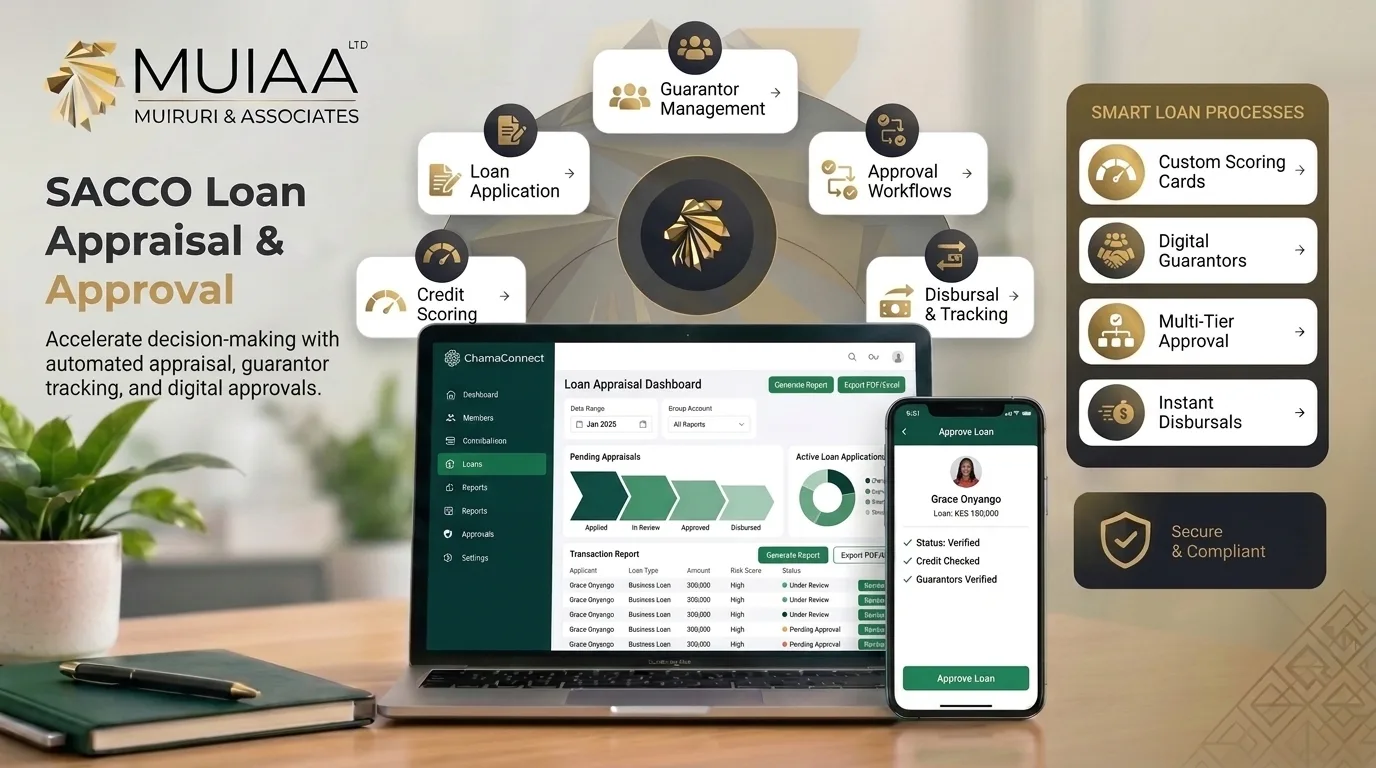
- Receiving applications.
- Checking eligibility.
- Assessing repayment capacity.
- Evaluating guarantors or other security where applicable.
- Obtaining the required approvals.
- Recording disbursement.
- Tracking repayments.
- Monitoring arrears.
- Closing or restructuring loans where approved.
A digital loan management system can organise these stages and make relevant information easier to review.
Automation should follow the SACCO’s approved credit policy. A software system shouldn’t independently replace the judgement and responsibilities of authorised credit officers or committees.
4d. Financial Reporting and Accounting
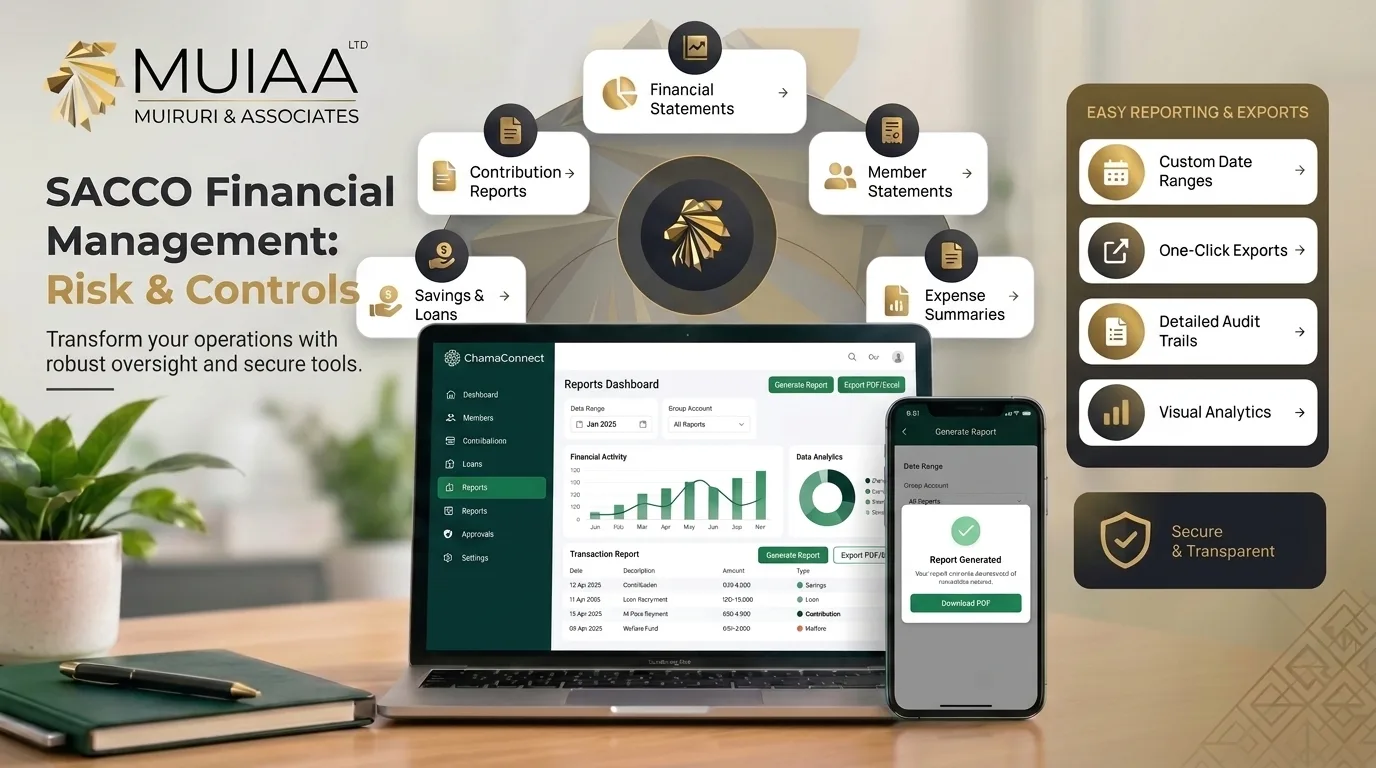
Digital financial systems can help SACCOs prepare reports using recorded transactions.
Depending on the system and its accounting capabilities, these may include:
- Member savings reports.
- Contribution summaries.
- Loan portfolio reports.
- Repayment and arrears reports.
- Income and expense reports.
- Reconciliation reports.
- Management performance summaries.
SACCOs should distinguish between operational reports and formal financial statements. They should also confirm that any system used supports their accounting framework and applicable reporting obligations.
4e. Member Communication
Digital communication tools can support:
- Payment notifications.
- Loan status updates.
- Repayment reminders.
- Meeting announcements.
- Statement access.
- General member notices.
The SACCO should establish which communications are official, who can send them and how members can update their contact preferences.
4f. Governance and Approval Workflows
A digital system can help define what different users are allowed to do.
For example, one officer may initiate a transaction while another authorised officer reviews or approves it.
The system should record important actions and apply permissions based on the SACCO’s governing documents, internal policies and applicable requirements.
5. What Technologies Support SACCO Digital Transformation?
A SACCO doesn’t need every available technology. It needs a suitable combination that addresses its actual operational requirements.
5a. SACCO Management Software
SACCO management software brings selected cooperative activities into a digital environment.
Depending on its scope, it may support member records, savings, loans, repayments, reporting, approvals and communication.
Some platforms focus on specific functions, while others offer broader core financial management capabilities.
Before choosing one, SACCO leaders should confirm whether the platform can support their products, processes, reporting needs and regulatory obligations.
5b. Mobile and Online Services
Mobile applications, web portals and other digital channels can make services more accessible.
Members may be able to view account information, submit requests, receive notifications or access statements.
The SACCO should also consider members who have limited internet access, older devices or lower levels of digital literacy.
Alternative service channels may remain necessary.
5c. Payment Integration
Payment integration connects a SACCO’s digital systems with the channels used to receive or disburse money.
In Kenya, this may involve mobile money services such as M-Pesa or relevant banking channels, depending on the provider and integration arrangements.
The purpose is to reduce manual reconciliation and improve transaction visibility.
A payment notification alone isn’t proof that the SACCO’s internal records have been updated correctly. The system should handle transaction references, confirmation statuses, reversals and reconciliation appropriately.
5d. Cloud Computing
Cloud computing allows organisations to access computing infrastructure, software and data storage through internet-based services.
For a SACCO, cloud-hosted software may reduce the need to maintain its own servers and technical infrastructure.
However, cloud adoption still requires careful review of:
- Data storage arrangements.
- Access permissions.
- Backup and recovery.
- Provider reliability.
- Security controls.
- Data location and cross-border transfer arrangements.
- Contractual responsibilities.
The SACCO remains responsible for assessing how its members’ information is handled.
5e. Artificial Intelligence and Automation
Artificial intelligence and automation can support selected administrative and analytical activities.
Possible applications include:
- Categorising enquiries.
- Extracting information from documents.
- Identifying unusual transaction patterns for review.
- Generating preliminary management summaries.
- Sending scheduled reminders.
- Supporting customer service.
AI-generated assessments should be reviewed before they influence important financial decisions.
A SACCO should also understand what information an AI tool processes, where that information goes and whether the provider is permitted to handle it.
5f. Blockchain Technology
Blockchain can support selected financial processes through shared transaction records and tamper-evident audit trails.
For SACCOs, potential applications include transaction verification, traceable financial activity and selected automated rules through smart contracts.
However, blockchain isn’t a complete SACCO management system by itself.
The organisation still needs accurate member information, sound accounting, clear approval processes, data protection and appropriate governance.
MUIAA explores these applications through its blockchain work, including ChamaConnect, its digital financial management platform for chamas and SACCOs.
6. How Should a SACCO Plan Its Digital Transformation?
A successful transformation begins with a clear plan. The SACCO should understand its current operations before selecting technology.
Step 1: Assess the SACCO’s Digital Readiness
Start by reviewing the systems, equipment, processes and skills already available.
Ask:
- Which activities are still managed on paper?
- Which processes depend on spreadsheets?
- Are different departments using separate systems?
- Where do errors and delays occur?
- Does the SACCO have reliable internet access?
- Do staff have the skills to use digital tools?
- Are members comfortable using digital channels?
- What security and data protection measures are already in place?
This assessment helps identify the areas that need attention first.
Step 2: Identify the Biggest Operational Problems
Avoid trying to digitise everything at once.
List the problems affecting daily operations and rank them according to their impact.
For one SACCO, the main challenge may be loan tracking. Another may struggle with payment reconciliation, member records or slow financial reporting.
Prioritise processes where digital improvements can produce clear operational benefits.
Step 3: Define Measurable Objectives
The SACCO should establish what it wants to improve.
Examples include:
- Reducing the time required to prepare monthly reports.
- Improving the accuracy of member balances.
- Reducing duplicate transaction entries.
- Improving loan repayment monitoring.
- Making member statements easier to access.
- Strengthening approval and activity records.
Where possible, record the current performance before implementation. This gives the SACCO a baseline for measuring progress.
Step 4: Map Existing Workflows
Document how each important process currently works.
For example, map the loan process from application to repayment.
Identify who receives the application, who checks eligibility, who approves it, how disbursement is recorded and how repayments are monitored.
Then identify where technology can simplify the process without removing necessary controls.
Step 5: Choose Suitable Technology
Evaluate software and service providers against the requirements identified during the assessment.
Consider:
- Supported SACCO operations.
- Accounting and reporting capabilities.
- Integration options.
- User permissions.
- Approval workflows.
- Data security.
- Backup and recovery.
- Vendor support.
- Training requirements.
- Data export and migration.
- Total cost of ownership.
Request a demonstration using realistic SACCO scenarios rather than relying only on marketing claims.
Step 6: Prepare and Verify Existing Data
Historical records may be stored in spreadsheets, paper files, accounting systems or other applications.
Before transferring them, the SACCO should:
- Identify the information that needs to be migrated.
- Remove duplicate or outdated entries where appropriate.
- Investigate inconsistent member details.
- Review outstanding loan balances.
- Reconcile important financial figures.
- Confirm opening balances.
- Assign people to verify the imported information.
Data migration is one of the most sensitive parts of digital transformation. Moving incorrect information into a new system doesn’t make it accurate.
Step 7: Test the New System
Before a full rollout, test the system using representative transactions and workflows.
Check whether:
- Member accounts are correctly created.
- Contributions appear against the right members.
- Loan calculations follow approved rules.
- Approval permissions work as intended.
- Repayments update the correct accounts.
- Reports match the underlying transactions.
- Notifications reach the intended users.
- Data can be recovered if something goes wrong.
A pilot involving a limited group of users can help identify problems before wider implementation.
Step 8: Train Staff and Members
People need to understand how the new system works and how their responsibilities may change.
Training should cover the tasks each user is expected to perform.
Staff may need training in transaction entry, approvals, reconciliation and reporting. Members may need guidance on accessing accounts, using digital channels and protecting their login information.
Provide support during the transition, especially for members who are less comfortable with technology.
Step 9: Roll Out in Stages
A phased rollout allows the SACCO to manage risk and resolve problems as they arise.
For example, it could begin with member records and contributions, then introduce loan workflows and reporting.
The exact sequence should depend on the system and the SACCO’s operational priorities.
Step 10: Monitor Performance and Improve
Digital transformation continues after implementation.
Review whether the system is delivering the intended improvements.
Monitor transaction accuracy, reporting time, system availability, member adoption, unresolved support requests and other relevant indicators.
Use the findings to improve workflows, training and system configuration.
7. Possible Challenges That SACCOs Face During Digital Transformation
Technology adoption can improve operations, but implementation comes with risks.
7a. High Initial and Ongoing Costs
Software subscriptions, hardware, connectivity, training, integrations and technical support can create costs.
SACCOs should assess the total cost of ownership rather than comparing software prices alone.
7b. Resistance to Change
Staff and members may be comfortable with familiar procedures.
Some may worry that automation will make their roles harder or reduce their control over information.
Clear communication, practical training and involving users in the transition can reduce resistance.
7c. Poor Data Quality
Historical records may contain missing details, duplicate accounts, inconsistent balances or unresolved transactions.
These problems should be investigated before migration.
7d. Cybersecurity Threats
Digital systems introduce risks such as phishing, stolen credentials, malware, unauthorised access and data breaches.
SACCOs should consider multi-factor authentication where available, access restrictions, secure backups, software updates, staff awareness and incident response procedures.
7e. Integration Problems
A new platform may not connect easily with existing accounting software, payment providers or other systems.
SACCOs should verify integration capabilities before signing contracts. They should also establish how information will be exchanged and reconciled.
7f. Limited Digital Skills
Some SACCOs may not have dedicated ICT teams.
They may need external technical support, staff training or managed services to maintain their systems.
7g. Poor Vendor Selection
A platform may look attractive during a demonstration but fail to support the SACCO’s actual workflows.
Evaluate the system against real operational requirements. Check support arrangements, data ownership, export options, security practices and contractual responsibilities.
8. Data Protection and Regulatory Rules for Kenyan SACCOs
Digital transformation increases the amount of personal and financial information handled through technology.
SACCOs should understand the legal and regulatory responsibilities that apply to their operations.
8a. The Kenya Data Protection Act, 2019
The Data Protection Act, 2019 establishes requirements for handling personal data in Kenya.
SACCOs should consider how they collect, use, store, share and protect member information.
Relevant principles include lawful and fair processing, transparency, collecting information for specified purposes, data accuracy, limiting unnecessary collection and retaining personal data only as long as necessary.
The Office of the Data Protection Commissioner (ODPC) oversees data protection compliance in Kenya.
SACCOs should determine whether they are required to register as data controllers or processors, depending on their activities and applicable registration requirements.
8b. Understanding Data Controller and Data Processor Responsibilities
A data controller determines the purposes and means of processing personal data.
A data processor handles personal data on behalf of a controller.
For example, a SACCO may determine why it collects member information and how it is used. A technology provider may process some of that information to provide software services.
The relationship should be clearly documented, including responsibilities for security, access, data handling and incidents.
8c. SASRA Requirements
The SACCO Societies Regulatory Authority supervises deposit-taking SACCOs and specified non-withdrawable deposit-taking SACCOs in Kenya.
The regulatory requirements applicable to a SACCO depend on its category and activities.
Regulated SACCOs should review relevant legislation, regulations, governance requirements, reporting obligations and any applicable ICT or cybersecurity guidance.
SASRA has also published draft ICT guidelines for regulated SACCOs through its stakeholder consultation process. SACCOs should distinguish draft guidance from final requirements and check the Authority’s current publications before making compliance decisions.
8d. Data Security and Member Privacy
SACCOs should establish controls covering:
- User authentication.
- Role-based permissions.
- Secure storage and transmission.
- Backup and recovery.
- Data retention.
- Third-party access.
- Incident reporting and response.
- Staff access to sensitive member information.
Digital transformation should improve operational access without exposing member information to unnecessary users.
9. How Can SACCOs Measure the Success of Digital Transformation?
A SACCO should measure operational improvements rather than judging success by the number of applications it has installed.
Useful indicators include:
| Area | What to measure |
|---|---|
| Member management | Time required to register and update member records |
| Contributions | Transaction processing time and unresolved payment differences |
| Loans | Application processing time and repayment tracking accuracy |
| Reporting | Time required to prepare management reports |
| Reconciliation | Number and age of unresolved discrepancies |
| Member services | Digital channel usage and support requests |
| Security | Access incidents, unresolved vulnerabilities and recovery readiness |
| Adoption | Percentage of intended users actively using the system |
| System performance | Availability, errors and support response times |
The SACCO should establish baseline measurements before implementation and review them regularly.
A digital system may reduce administrative work, but the improvement should be demonstrated through actual operating results.
10. What Should SACCOs Look for in a Digital Transformation Partner?
Some SACCOs may have the internal capacity to manage technology projects. Others may need support from software providers, consultants or technical partners.
A suitable partner should understand the SACCO’s operational environment and be able to explain how its technology addresses specific requirements.
Evaluate potential partners based on:
- Industry understanding: Do they understand savings, lending, member management and cooperative governance?
- Functional coverage: Can their system support the SACCO’s actual processes?
- Integration capability: Can it connect with the SACCO’s existing systems and payment channels?
- Data protection: Can they explain how member information is handled and protected?
- Security: Are access controls, backups and incident response arrangements clearly documented?
- Implementation support: Do they provide data migration, configuration and training?
- Reporting: Can the system produce useful and verifiable reports?
- Scalability: Can it support the SACCO as its membership and activities grow?
- Data portability: Can the SACCO export its information if it changes providers?
- Transparency: Are pricing, limitations, service commitments and responsibilities clearly explained?
A technology partner should be able to demonstrate the system using the SACCO’s real-world requirements.
11. MUIAA’s Role In Supporting Digital Transformation of SACCOs
At MUIAA Ltd, we explore how emerging technologies can address practical challenges facing African financial institutions, cooperatives and community-based savings groups.
Our work includes blockchain-powered solutions designed around financial management, transaction traceability and more transparent digital processes.
One example is ChamaConnect, MUIAA’s digital financial management platform for chamas and SACCOs. It supports activities such as member management, contributions, savings, loans, financial activity and reporting.
The platform also incorporates role-based access and activity logging. Its blockchain-backed audit trail supports the traceability of selected financial and administrative activity.
This approach reflects an important part of digital transformation. Technology should make financial processes easier to manage while supporting accountability and reliable records.
Blockchain is one part of the wider technology environment. SACCOs still need sound financial policies, accurate information, trained users and appropriate internal controls.
MUIAA’s focus is on developing practical technology solutions that respond to the needs of African organisations and communities.
Explore MUIAA’s technology solutions and learn more about ChamaConnect.
Frequently Asked Questions
a. What is digital transformation in a SACCO?
Digital transformation in a SACCO is the process of improving its operations and member services through technology, connected systems, redesigned workflows and better data management. It can cover membership, savings, loans, payments, reporting, communication and governance.
b. Why is digital transformation important for SACCOs in Kenya?
It can help SACCOs reduce repetitive administrative work, improve transaction visibility, strengthen reporting, support member access and improve internal controls. The benefits depend on the technology selected and how well it is implemented.
c. What is the difference between SACCO digitisation and digital transformation?
Digitisation converts physical information into digital formats. Digital transformation involves broader organisational change through technology, connected processes, improved services and new ways of managing operations.
d. What software does a SACCO need?
The requirements depend on the SACCO’s size, structure and activities. Common needs include member management, savings and contribution tracking, loan management, repayments, accounting, reporting, user permissions and payment integration.
e. How much does SACCO digital transformation cost in Kenya?
There isn’t one fixed cost. Expenses depend on the software, number of users, implementation requirements, integrations, training, hardware, support and ongoing subscriptions. SACCOs should compare the total cost of ownership and the operational value expected.
f. How long does it take to digitise a SACCO?
The timeline depends on the SACCO’s existing systems, data quality, number of members, operational complexity and implementation scope. A smaller project may take less time than a transformation involving several departments and integrations. A phased rollout can make the process easier to manage.
g. Is blockchain necessary for SACCO digital transformation?
No. Blockchain is an optional technology for selected use cases. Many SACCO operations can be managed through conventional digital systems. Blockchain may add value where tamper-evident records, transaction traceability or programmable rules are useful.
h. How does the Data Protection Act affect SACCO digital transformation?
The Data Protection Act, 2019 governs how personal information is processed in Kenya. SACCOs should consider lawful processing, transparency, data security, access rights, retention and their responsibilities as data controllers or processors.
i. Can a small SACCO benefit from digital transformation?
Yes. A smaller SACCO can begin with a few high-priority processes, such as member records, contributions or loan tracking. It can expand its digital operations as its needs and capacity grow.
j. What is the first step in SACCO digital transformation?
The first step is a digital readiness assessment. The SACCO should review its current processes, identify operational problems, examine its data and technology infrastructure, and establish measurable objectives before selecting software.
Conclusion: Building a Digitally Ready SACCO
Digital transformation gives Kenyan SACCOs an opportunity to improve how they manage members, financial activities, reporting and internal operations.
The transition works best when it begins with a clear understanding of existing processes. SACCO leaders should identify operational gaps, establish priorities, prepare their data, select suitable technology and involve staff and members throughout implementation.
Security, data protection and governance should remain part of the process from the beginning.
The goal is to build an operating environment where information is reliable, financial activities are easier to track, decisions are supported by useful data and members can access services more conveniently.
For SACCOs planning this journey, the next step is to assess their needs and identify the digital tools that can support their long-term operations.